- Mission will mark the first time a foreign national visits China's Tiangong space station, with Ali participating in joint scientific experiments before returning to Earth
- Flight is part of Beijing's efforts to expand international cooperation as it develops its independent space program and plans a crewed lunar landing by 2030
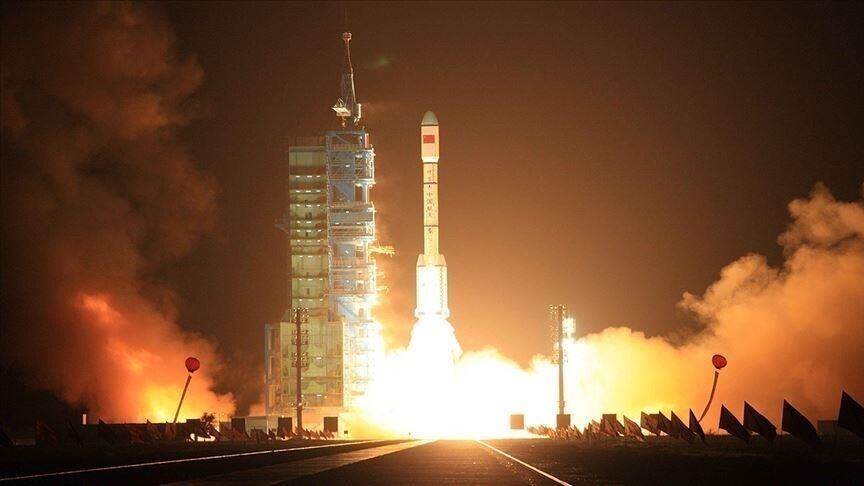
China is set to launch its Shenzhou-24 crewed spacecraft on Wednesday, carrying a Pakistani astronaut who will become the first foreign national to visit its Tiangong space station.
The China Manned Space Agency (CMSA) officially announced the three-member crew on Tuesday, naming Pakistani astronaut Muhammad Zeeshan Ali alongside Chinese astronauts Tang Hongbo and Wu Yi.
The spacecraft is scheduled to lift off at 8.18 a.m. Beijing time (0018GMT) from the Jiuquan Satellite Launch Center in northwestern China's Gansu province aboard a Long March-2F rocket.
Ali, a Pakistan Air Force pilot, will serve as a payload specialist, joining the mission for a short-duration stay in orbit focused on scientific research under a bilateral cooperation program between Islamabad and Beijing.
"I've been going through the trainings, like the centrifuge training, the rescue survival training,the emergency procedure training. But the real challenge honestly was mastering the Chinese language."
“Because all the switches, all the software, all the programs, all the voice announcements, everything is Chinese,” Ali said in a video shared by The Global Times newspaper.
The landmark mission follows an agreement the two countries signed in February last year in Islamabad under which a Pakistani astronaut would become the first foreign national to visit China's space station.
It also follows the announcement that a Pakistan rover would take part in China's Chang’e 8 mission to the lunar south pole in 2028.
The mission will make Ali the first Pakistani to travel into space.
China's Tiangong space station
The Shenzhou-24 spacecraft will travel to Tiangong, China's independently developed space station orbiting approximately 400 kilometers (248 miles) above Earth.
The station consists of three main modules: Tianhe, its central living and control module; Wentian, which supports scientific experiments and astronaut activities; and Mengtian, designed primarily for research and technological testing.
China launched the Tianhe core module in April 2021, followed by Wentian in July 2022 and Mengtian in October 2022, completing the station's basic three-module configuration in November that year.
Tiangong provides a permanent platform for scientific research, technological development and long-term human spaceflight.
It is designed to accommodate three astronauts during routine operations, with additional capacity during crew rotations.
The Shenzhou-24 flight is the 41st mission of China's crewed space program and the eighth crewed mission during the development and operational phase of its space station, according to Chinese authorities.
China's space ambitions
Once dominated by the US and Russia, space exploration has increasingly become central to Asia’s technological development, security planning and geopolitical positioning.
In 2011, Beijing was barred from participating in the International Space Station program after the US Congress restricted NASA's cooperation with Chinese space agencies, citing national security concerns.
Beijing has since sought to build partnerships with other countries – including Pakistan – as part of its expanding space program.
Through cooperation with the UN Office for Outer Space Affairs (UNOOSA), China has created opportunities for international institutions to conduct scientific experiments aboard its space station.
The program provides countries with less-developed space industries an opportunity to participate in orbital research without having to establish their own launch systems and space station infrastructure.
China’s space program has become inseparable from its broader ambition to challenge US technological leadership and reduce reliance on Western-controlled infrastructure.
The country moved from investing only a few hundred million dollars annually at the start of the century to around $19 billion a year, making it one of the world's largest space spenders and surpassing Japan in annual investment.
China’s commercial space sector has also expanded rapidly since 2014, attracting $2.9 billion in private investment in 2024 alone, driven by launch startups and satellite manufacturers.
Central to that strategy is the push for autonomous infrastructure.
In 2020, China developed its own positioning, navigation and timing infrastructure – known as BeiDou – a move analysts see as Beijing's bid to develop autonomous infrastructures in order to achieve full independence in the space domain.
The BeiDou navigation system was designed to reduce reliance on the US Global Positioning System while offering an alternative positioning service to partners in Africa, Latin America and Southeast Asia.
The same rationale drove China’s indigenously developed Tiangong space station, which became humanity’s second fully operational space station in 2022.
Beijing has also designated satellite internet as part of its new infrastructure ambitions, triggering major investments in satellite systems that would provide broadband internet and other services – reducing reliance on foreign systems like Starlink and Europe’s Eutelsat.
China’s ambitions even extend to the Moon.
Alongside Russia, Beijing launched the International Lunar Research Station project in 2021, positioning it as an alternative to NASA’s Artemis program with particular appeal to Global South countries.
Between 2003 and 2025, China conducted 16 crewed space missions, most recently launching Shenzhou-21 in late October 2025.
Beijing has also begun inviting foreign astronauts to fly aboard Chinese missions, selecting Pakistan for its first such collaboration after Islamabad launched satellites using Chinese infrastructure.
3 decades of space partnership
Pakistan's Planning and Development Minister Ahsan Iqbal arrived in China on Sunday to attend the launch.
"Looking forward to exciting times ahead as we take our very first step toward space travel," Iqbal posted on US social media company X.
Islamabad, which initially focused on satellite development and launches, is now expanding its space program into more advanced areas.
The latest agreement between CMSA and Pakistan’s Space and Upper Atmosphere Research Commission (Suparco) builds on over three decades of space cooperation.
It began in 1990, when Pakistan launched its first experimental satellite, Badr-1, aboard a Chinese rocket from the Xichang Satellite Launch Center.
Since then, the partnership has continued to produce joint achievements.
Chinese and Pakistani flags were sent aboard the Long March-2F carrier rocket in June 2021 and returned to Earth aboard Shenzhou-12 after the spacecraft spent three months in orbit.
The flags were sent by CMSA to outer space to commemorate the 70th anniversary of the establishment of diplomatic relations between the two allies.
In April 2026, Pakistan's PRSC-EO3 remote-sensing satellite was successfully placed into orbit aboard a Chinese Long March-6 rocket, further strengthening cooperation in satellite technology and space-based observation.