Anadolu Ajansı © 2026


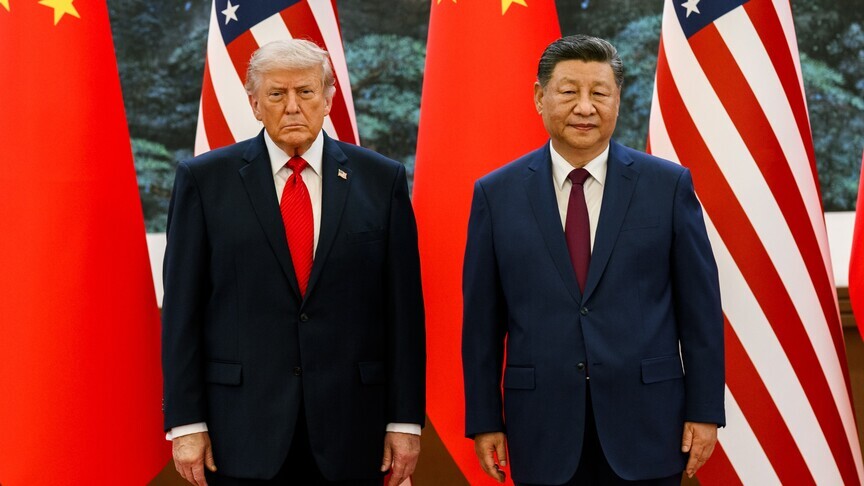
US President Donald Trump’s summit with Chinese President Xi Jinping in Beijing highlighted a growing effort by the world’s two largest powers to stabilize ties through trade and economic cooperation, even as deep divisions over Taiwan, technology, tariffs and regional security remain unresolved.
During Trump’s visit last week, the two leaders held multiple meetings focused on trade, investment and global security issues, including the conflict involving the US, Israel and Iran, while unveiling a series of economic initiatives aimed at easing tensions after years of escalating rivalry.
Analysts told Anadolu that both Washington and Beijing appear eager to prevent further deterioration in relations at a time of mounting geopolitical instability linked to conflicts in the Middle East and Ukraine.
“Neither side wants uncontrolled escalation right now, particularly amid economic uncertainty and wider geopolitical instability connected to Iran and global supply chains,” Nancy Snow, scholar of public diplomacy and professor emeritus at California State University, told Anadolu.
She described the meeting as less a breakthrough summit than a “stabilization summit.”
“Both leaders were eager to lower the temperature in US-China relations without fundamentally resolving their strategic differences,” she said. “The symbolism, optics, and choreography mattered as much, if not more, than the policy discussions themselves.”
William Yang, Crisis Group’s senior analyst for Northeast Asia, said the summit projected an image of both sides trying to preserve stability.
“Beijing and Washington both need to ensure there is a degree of stability in their bilateral relationship so they have more bandwidth to deal with the pressing uncertainty and challenges extending from the ongoing conflict in the Middle East, as well as the Russia-Ukraine war,” he said.
Yang said both Trump and Xi appeared focused on sustaining relatively stable economic relations while avoiding further confrontation.
“As a result, I would characterize the summit as being successful in terms of upholding the temporary trade truce between the two countries,” he said.
Beijing-based analyst Einar Tangen described the meeting as a significant moment in the broader evolution of the international order.
“Not because rivalry ended, but because it is increasingly understood that the best hope for the future international system will not be shaped by absolute dominance, but by the ability to provide stability, development, sustainability and workable frameworks for coexistence in an increasingly multipolar world,” he said.
The summit produced a series of economic announcements aimed at rebuilding confidence in commercial ties after years of trade disputes and technology restrictions.
A White House statement said the two countries agreed to establish two new bilateral institutions: the US-China Board of Trade and the US-China Board of Investment.
China also approved an initial purchase of 200 Boeing aircraft for Chinese airlines, marking its first major commitment to buy American-made Boeing planes since 2017.
Beijing further pledged to purchase at least $17 billion annually in US agricultural products between 2026 and 2028 and restore market access for hundreds of American beef facilities.
The White House also said China agreed to resume poultry imports from US states deemed free of highly pathogenic avian influenza.
Snow said the economic deliverables appeared designed more to create momentum and market confidence than to finalize comprehensive long-term agreements, and that the language surrounding the deals remained deliberately vague.
“At this stage, many of the announced agreements appear aspirational rather than fully institutionalized,” she said.
“The Boeing discussion is particularly important symbolically because it would signal that China is willing to restore some confidence in commercial ties with the United States after years of trade friction,” she added.
Experts said Beijing’s emphasis on economic cooperation also reflected a broader Chinese effort to prevent further deterioration in ties with Washington at a time of growing instability.
“China values consistency more than concessions,” Tangen previously told Anadolu. “Trump’s unpredictability is itself a strategic liability from Beijing’s perspective.”
Technology cooperation also emerged as a key issue during the summit, particularly regarding advanced semiconductor exports.
Nvidia CEO Jensen Huang joined the delegation of American business leaders traveling with Trump to Beijing, highlighting the growing importance of artificial intelligence and semiconductor policy in US-China relations.
Snow described the issue as strategically significant.
“Advanced AI chips are now deeply tied to national security competition,” she said.
"If Washington allows expanded Nvidia sales into China, even selectively, it suggests the Trump administration may be looking for a more commercially flexible approach than a purely containment-based strategy.”
Despite the emphasis on economic cooperation, analysts said the summit did little to resolve the most contentious geopolitical disputes between the two powers.
According to the White House, Trump and Xi discussed Iran, the Strait of Hormuz and North Korea during their meetings.
The two leaders reportedly agreed that Iran should not obtain a nuclear weapon and supported reopening the Strait of Hormuz following months of disruption to global shipping routes.
For Snow, the relatively limited public discussion of Taiwan during the summit was revealing.
“Taiwan remains the most dangerous flashpoint in US-China relations, but both sides appeared careful not to inflame tensions publicly during the visit,” she said.
Snow argued that Trump appears less ideologically focused on Taiwan than previous US administrations.
“For Xi Jinping, Taiwan is a core sovereignty issue and central to China’s national narrative,” she said. “For President Trump, openly escalating the Taiwan issue during a summit focused on economic stabilization would have undermined the broader tone of cooperation he was trying to project.”
Yang noted that Trump later acknowledged discussing Taiwan extensively with Xi during private conversations, particularly regarding US arms sales to Taipei.
“However, Trump also acknowledged that he hadn't decided if he would approve the $14 billion arms package to Taiwan and said he would make a decision at a later stage,” Yang said, referring to the contentious issue of US arms sales to Taiwan, which Beijing views as interference in its internal affairs.
Analysts said the summit ultimately reflected a broader shift in how both countries are managing their increasingly competitive relationship.
“The US-China relationship is evolving toward a more transactional and economically managed relationship, particularly under Trump’s leadership style,” Snow said.
“Trade, technology access, investment, agriculture, aviation, and energy appear to be the dominant organizing principles right now."
She cautioned, however, against concluding that the relationship is becoming purely economic in nature.
“The geopolitical rivalry remains very real,” she said.
Trump is expected to welcome Xi to Washington this fall, while both governments said they would support each other as hosts of the G20 and APEC summits later this year.
Snow noted that the proposed timing of the Washington summit would come around six weeks ahead of US midterm elections.
“I could imagine Trump wanting to make a big trade deal announcement then to send the Dow Jones average soaring,” she said. “He’s that kind of business guy.”
news_share_descriptionsubscription_contact