Russia and Ukraine traded accusations Friday over overnight drone attacks targeting logistics, port and other infrastructure, with Ukrainian authorities reporting at least three deaths and 27 injuries.
In Russia, acting Tver Governor Vitaly Korolev said on Russian social media platform Max that debris from a Ukrainian drone damaged the wall of a warehouse belonging to Wildberries, the country's largest online retailer, in the Kalininsky district.
"The resulting smoke was quickly extinguished. No employees were injured. Emergency services are on site to ensure the continued safety of the facility," Korolev said.
Wildberries confirmed the attack on Telegram, saying its logistics facility sustained minor damage but was evacuated in accordance with safety regulations. No goods were damaged.
Ukraine has intensified drone strikes on Wildberries logistics facilities in a campaign that began in mid-July and has spread across several Russian regions.
Since July 18, Ukrainian drones have targeted Wildberries logistics centers in the Moscow, Tambov, Leningrad, Krasnodar, Volgograd and Stavropol regions, as well as in Crimea, which Russia annexed in 2014.
Kyiv has accused the e-commerce retailer of playing a role in Moscow's military supply chain, while Moscow and Wildberries maintain that the facilities are purely civilian.
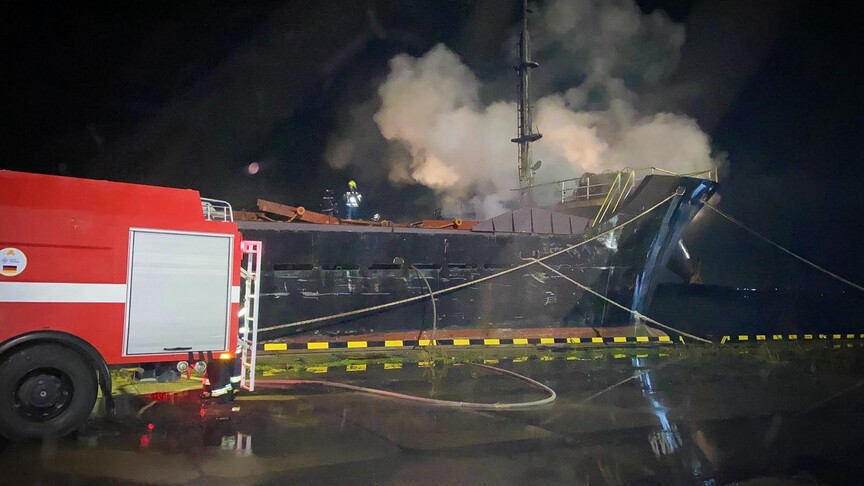
Separately, Leningrad Governor Aleksandr Drozdenko reported damage and a fire at the Baltic port of Ust-Luga following a Ukrainian drone attack.
"All consequences of the attack in the port of Ust-Luga have been cleared. There are no casualties," Drozdenko later said, claiming 54 Ukrainian drones were downed during the attack.
In a later statement, Ukraine's General Staff confirmed targeting Ust-Luga, claiming that, according to preliminary information, it struck two processing units at a gas condensate processing complex operated by Novatek, Russia's second-largest natural gas producer.
Russia's Defense Ministry claimed its air defenses shot down a total of 553 Ukrainian drones over 18 regions, as well as over the Black Sea, the Sea of Azov and Crimea.
Strikes in Ukraine
In Ukraine, the State Emergency Service said five people were injured in a Russian drone strike on the city of Smila.
"Damage and fire occurred in a nine-story residential building," it said, adding that firefighters extinguished the blaze caused by the strike.
The Izmail District State Administration in the southern Odesa region said Russian strikes hit local infrastructure and sparked several fires, which were quickly extinguished by emergency crews.
In the northeastern Sumy region, Gov. Oleh Hryhorov said two people were killed and four others injured when Russian drones struck a residential building.
In the eastern Donetsk region, Gov. Vadym Filashkin said one person was killed and 18 others injured in an airstrike on the city of Kramatorsk that damaged an apartment building.
Ukrainian President Volodymyr Zelenskyy said strikes were also reported in several other regions.
"Every day, Russia uses about 220 guided aerial bombs against our frontline communities, which the aggressor's defense industry continues to produce and modify despite sanctions," Zelenskyy said on US social media platform X.
"Pressure is needed on every supply chain for foreign components and every enterprise working to enable strikes against lives," he added.
Ukraine's Air Force claimed its air defenses downed 90 of 112 drones launched by Russia overnight.
Russia's Defense Ministry, meanwhile, claimed its forces struck two seagoing tugboats in the Black Sea southwest of Mykolaiv late Thursday, alleging they were "used to escort dry cargo ships carrying Western weapons" for the Ukrainian military.
It also said Russian drones struck the railway station at the port of Izmail overnight, claiming the facility was “used for loading, storing, and transporting military cargo and fuel.”
Independent verification of claims by Russia and Ukraine is difficult due to the ongoing war.
Moscow and Kyiv have increasingly targeted each other's logistics centers as well as port and energy infrastructure during the ongoing war.
Both sides deny deliberately targeting civilian infrastructure, maintaining that their strikes are directed at military targets or facilities linked to military activities.