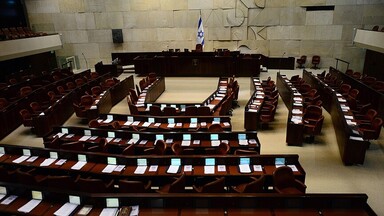
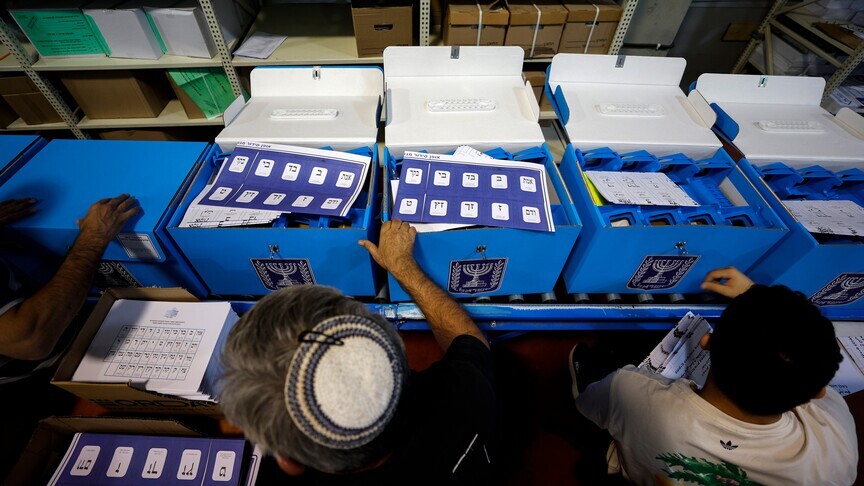
Israel’s election last week left both Prime Minister Benjamin Netanyahu and opposition leader Gadi Eisenkot short of a majority, with their paths to power running through parties they or their allies have pledged to shun.
The final count gave Netanyahu’s bloc 53 seats in the 120-member Knesset and Eisenkot’s bloc 48. Two Arab-led parties, the Joint List and Ra’am, won a record 19 seats between them, putting them in a decisive position.
“At the moment Netanyahu can’t – mathematically speaking – form a coalition with a Knesset majority,” Ahron Bregman, an Israeli political analyst and senior teaching fellow at King’s College London, told Anadolu.
Netanyahu's Likud party has accused the Arab-led parties of stealing the election without providing evidence. On Sunday, Central Elections Committee Chairman Noam Sohlberg said that even if investigators substantiated suspicions of foreign interference, the overall result would stand.
"What he (Netanyahu) does is try to prevent the other side from forming a coalition by – and this is classic Netanyahu – blaming the Arabs, who did well in the election and could help the opposition to form a coalition, of stealing the elections,” said Bregman.
Forming a government may now depend on who is willing to break a campaign pledge, whether over cooperation with Arab parties, military exemptions for ultra-Orthodox men or serving under Netanyahu.
President Isaac Herzog has urged political leaders to approach coalition negotiations with an open mind and do everything possible to avoid another election.
Here are five ways the situation could unfold.
Eisenkot could seek to form a government with the opposition's 48 seats and the backing of the Joint List and Ra'am, which together hold 19 seats. Their combined support would bring the potential parliamentary majority to 67.
However, this would require major political compromises.
The Times of Israel reported that three of the four main opposition parties – Yashar, B’Yachad and Yisrael Beytenu – had pledged during the campaign not to form a government with Arab parties.
Only the Democrats, led by Yair Golan, had openly supported such cooperation.
Yisrael Beytenu leader Avigdor Liberman reiterated over the weekend that his party would not participate in a government that relied on Ra'am or the Joint List. Without his seven lawmakers, the remaining opposition parties and both Arab-led factions would hold just 60 seats.
The two Arab-led parties also differ in how they might support a government.
Ra'am leader Mansour Abbas has signaled that his party is open to joining an Eisenkot-led government. The Joint List is prepared to back such a government from outside the coalition but does not want to join it, senior party figure Ahmad Tibi said over the weekend.
Eisenkot would therefore have to reconsider his campaign position and accept Arab parties' support, either inside or outside the government.
An early test of cooperation could come when the new Knesset convenes Nov. 10. Opposition parties have discussed replacing Likud's Amir Ohana as speaker, a move that would require cooperation among opposition parties before a government is formed.
"Inviting Arab parties to join the coalition will be historic and a first step in integrating Arabs living in Israel into Israeli society,” said Bregman, adding that rejecting the Arabs, 21% of the Israeli population, "cannot continue forever."
Netanyahu could remain in power by persuading individual lawmakers or smaller opposition factions to join him.
His bloc needs eight more seats for an outright majority, though opposition parties campaigned on removing him from office.
Another theoretical possibility would be cooperation with Ra'am, which holds eight seats. However, Netanyahu's far-right partners, including Itamar Ben-Gvir and Bezalel Smotrich, have strongly opposed an arrangement involving Arab parties.
A similar effort ran aground in 2021. Netanyahu explored forming a government with Ra'am's backing, but far-right ally Smotrich refused to join a coalition that relied on the party even for outside support.
Abbas went on to join the coalition led by Naftali Bennett and Yair Lapid, making Ra'am the first independent Arab party to enter an Israeli government.
A national unity government bringing together Likud and opposition parties could command a comfortable majority.
Likud, Eisenkot's Yashar, Bennett and Lapid's B'Yachad and Avigdor Liberman's Yisrael Beytenu would together hold 67 seats.
The obstacle is who would lead it. Eisenkot, Bennett and Liberman have all opposed serving in a Netanyahu-led government. A deal could also require Netanyahu to break with longtime allies.
Ynet previously reported that Herzog had been linked to efforts to encourage a unity arrangement, but the president's office categorically denied that he had discussed any specific coalition with politicians.
A unity government could become an option if other negotiations fail, but it would require opposition leaders to reverse their campaign commitments and Netanyahu to reconsider his current political alliances.
Eisenkot could seek to form a government with fewer than 61 lawmakers in his coalition if he secured enough support to win a confidence vote. Arab-led parties or ultra-Orthodox lawmakers could help him without formally joining the coalition.
The Times of Israel, citing Channel 12, reported Thursday that figures in United Torah Judaism (UTJ) were considering supporting an Eisenkot-led government by abstaining in parliamentary votes rather than joining the coalition.
UTJ holds seven seats and has been frustrated with Netanyahu over his failure to pass legislation protecting ultra-Orthodox men from compulsory military service.
However, military service remains a major obstacle. Eisenkot and his partners have called for an end to blanket exemptions for ultra-Orthodox men, while UTJ has sought to preserve them.
The Jerusalem Post reported Friday that UTJ was emerging as a possible negotiating partner for the opposition.
Eisenkot has authorized his team to explore whether a minority government could take office if Ra'am and UTJ abstained, Ynet reported Sunday. The proposal also assumes the Joint List would not vote against him.
A minority government could therefore depend on a combination of abstentions and outside support. The precise parliamentary arrangements would be crucial.
If neither Netanyahu nor Eisenkot can secure sufficient support, Israel could face another parliamentary election.
Herzog is expected to receive the official election results Nov. 4 and then consult representatives of the Knesset factions before deciding who should receive the mandate to form a government.
The selected candidate would have 28 days to form a coalition, with the possibility of a 14-day extension. If that attempt fails, Herzog could give another candidate an opportunity.
Lawmakers have one final opportunity to avert an election. During a 21-day window, at least 61 members of the Knesset can jointly request that a candidate of their choice be given the mandate.
If no government emerges, Israelis return to the polls, with Netanyahu remaining caretaker prime minister in the meantime.
It would be familiar territory for Israeli voters, who went to the polls five times between 2019 and 2022.
news_share_descriptionsubscription_contact

contact_the_ombudsman
is_there_an_error_in_this_story