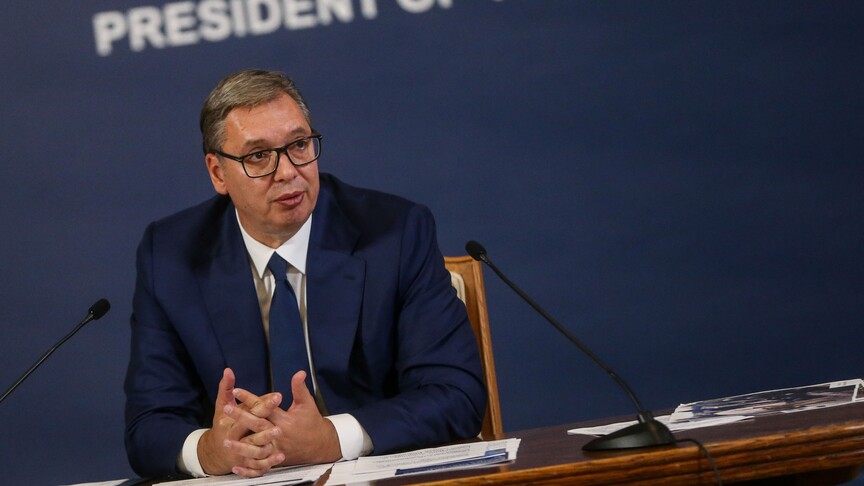
Former Serbian President Aleksandar Vucic is leaving the presidency in an attempt to remain in power. His resignation on Sept. 27, ahead of the early elections on Oct. 25, should be understood above all as an effort to continue leading the country as prime minister. Yet this maneuver is unfolding under circumstances he does not fully control, as sustained popular protests have now produced an electoral challenger.
Constitutional term limits explain why Vucic is seeking another office, but not why he stepped down seven months before his term expired. The timing appears intended to transform pressure on his administration into a contest for a new mandate. By taking the initiative in moving from the presidency to the premiership, he is trying to determine the terms of his own political continuity.
Moving from the presidency to the premiership is not a Serbian invention. Vladimir Putin took this route in 2008 before returning to the presidency in 2012. The analogy, however, has its limits. In Serbia, Vucic's success will depend on a parliamentary majority that must either be won outright or assembled with allies. A first-place finish for the Serbian Progressive Party (SNS) would not automatically secure his election as prime minister.
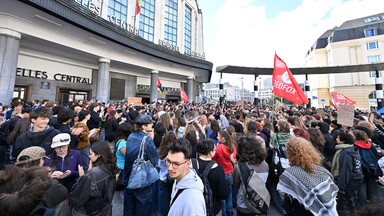
The weakness of this strategy lies in the origins of the crisis. The collapse of the Novi Sad railway station canopy in November 2024, which killed 16 people, sparked a civil movement. Elections can determine who governs, but they do not establish responsibility for the disaster. Even a Vucic victory would not answer the demand for investigations and justice for the victims.
The most significant change in the political landscape is the student movement’s entry into the electoral contest. Its candidate list includes academics and professionals, giving the protest movement representation beyond the universities. The Democratic Party and the Kreni Promeni movement have chosen to support it without fielding candidates of their own. This shifts the confrontation from putting pressure on the government to potentially depriving the ruling party of its parliamentary majority.
The opposition, however, is not a single bloc. Other forces are competing alongside the student list, including the pro-European coalition European Serbia. The challenge is to unite voters who oppose Vucic but do not necessarily share the same political priorities. The trust earned through protest is an advantage; preserving it during negotiations over a program and alliances will be a further test.
The political atmosphere is characterized by a combination of civic mobilization, polarization, and distrust of institutions. The willingness to protest and organize shows that society has not resigned itself to the status quo. Yet the unsubstantiated accusations portraying opponents as foreign agents shift the focus away from citizen grievances, narrowing the space for constructive democratic dialogue. When political opponents are portrayed as enemies of the country, the legitimacy of political competition and the acceptance of electoral defeat are generally called into question.
Uncertainty about the outcome should therefore not be confused with a level electoral playing field. The OSCE/Office for Democratic Institutions and Human Rights (ODIHR) report on the 2023 elections identified the structural advantages enjoyed by those in power. The mission deployed for this October’s vote will also assess media coverage, campaign financing, and electoral complaints. Observation matters, but the decisive test is whether institutions can remedy violations and ensure that the same rules apply to all contestants.
What can be expected from the elections? First, substantial parliamentary representation for the student list, which would reshape the opposition even if Vucic succeeds in forming a government. Second, the distribution of seats among smaller lists is likely to carry considerable weight in determining the majority. There are insufficient grounds to declare a winner at this stage. An NSPM poll narrowly favors the students, while Faktor Plus places Vucic's list ahead. These surveys were done at different times and should be interpreted cautiously. The elections are likely to institutionalize the challenge to the government but will not automatically resolve the crisis of trust between those in power, citizens, and opposition forces.
The significance of this confrontation, however, extends beyond domestic politics. The European Union is seeking to attract Serbia through the prospect of membership, investment, and economic integration, with the aim of drawing it away from Russia and towards Europe’s strategic orientation. The problem lies in the assumption that economic benefits will produce a lasting geopolitical alignment. Belgrade can benefit from its relations with Europe while maintaining its political ties with Moscow and using the competition between them to expand its maneuvering room. Within this relationship, treating Vucic as an indispensable guarantor of stability creates a contradiction because it risks supporting a policy that uses instability as a source of influence.
In Bosnia and Herzegovina, Belgrade’s support for former Republika Srpska President Milorad Dodik as well as Republika Srpska’s separatist policies fuels confrontation with state institutions. Vucic's condemnation of the judicial ruling against Dodik in February 2025 illustrates this political protection. Declarations of respect for the 1995 Dayton Agreement lose credibility when accompanied by support for actors who challenge Bosnia’s institutional order.
Vucic's political background helps explain this orientation. His longstanding collaboration with Vojislav Seselj and the Serbian Radical Party places his political formation within Serbian far-right. Seselj was convicted of crimes against humanity, while Vucic remained in his party until the split in 2008. This legacy is also evident in the public glorification of wartime figures. On Sept. 7, the late Ratko Mladic, convicted in 2017 of genocide, war crimes, and crimes against humanity, was buried in Belgrade with military honors and hailed by supporters as a national hero. Serbian government ministers attended the ceremony, although Vucic himself was absent. Honoring a figure convicted of such crimes demonstrates the absence of a political and symbolic break with the nationalism of the wars of the 1990s. Vucic's image as a pragmatic European partner must therefore also be judged against the way his government confronts this legacy.
Serbia’s geostrategic continuity, however, cannot be explained solely by one individual’s biography. Relations with Russia rest on historical ties, cultural and religious affinities, and state interests, particularly in energy and Moscow’s support for Serbia’s position on Kosovo. For this reason, fundamentally different behavior is not to be expected even if Vucic is removed from power. A majority united against corruption does not necessarily constitute a majority in favor of reassessing these interests.
Ultimately, the prospect of democratic change at home should therefore not encourage unfounded optimism about a geopolitical shift. Such a shift would require a change in policy towards neighboring states and respect for their sovereignty.
*Opinions expressed in this article are the author's own and do not necessarily reflect the editorial policy of Anadolu.
news_share_descriptionsubscription_contact

contact_the_ombudsman
is_there_an_error_in_this_story