The US disclosure that it has deployed weapons in orbit does raise concerns over the safety and sustainability of an increasingly crowded space environment, even if the capabilities themselves are not new, according to the head of the UN’s space office.
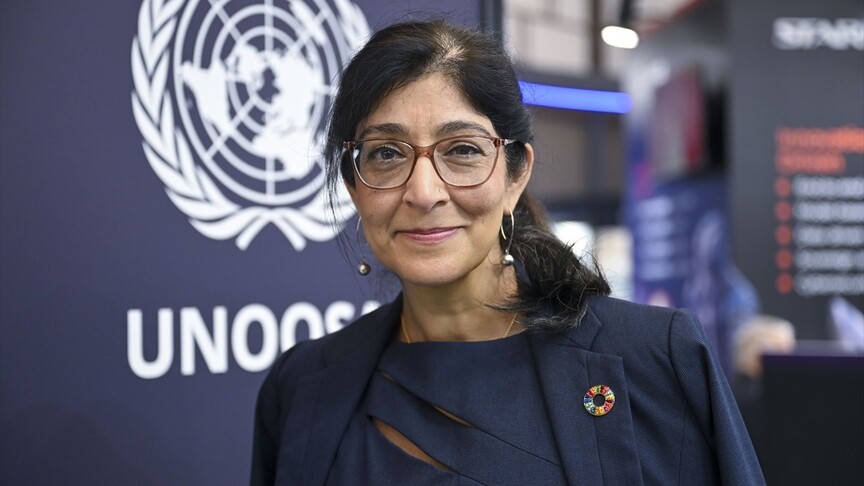
Aarti Holla-Maini, director of the United Nations Office for Outer Space Affairs (UNOOSA), said her Vienna-based office deals with the safety and sustainability of space activities. Security, she said, falls under the UN Office for Disarmament Affairs.
“So we are not concerned with security in principle. However, to the extent that these things can affect sustainability and safety, it is a concern,” she told Anadolu on the sidelines of the 77th International Astronautical Congress (IAC) in Antalya.
“I don’t believe that the US has put capabilities out there which do not already exist. The difference is that they have announced it.”
On Sept. 14, US Air Force Secretary Troy Meink told a defense conference in Maryland that the US has “on-orbit space control weapons capable of defending the Joint Force against hostile adversary action.” It was the first official acknowledgment that Washington has weapons in orbit.
Meink did not identify the systems.
In a statement to The War Zone, a US defense news website, a Space Force spokesperson said space control involves “kinetic and non-kinetic means” to affect adversary capabilities “through disruption, degradation and even destruction, if necessary.”
China’s Foreign Ministry urged Washington “to stop expanding its military buildup in outer space.”
Kremlin spokesman Dmitry Peskov said Moscow believes space should be free of weapons and called for its complete demilitarization.
Opening the congress in Antalya on Monday, Turkish President Recep Tayyip Erdogan also warned against the militarization of space, saying that sending weapons there or turning it into an arena for an arms race would be “totally wrong.”
European Space Agency (ESA) Director General Josef Aschbacher, also speaking to Anadolu at the congress, said Europe does not deploy weapons in space but is watching developments “very carefully.”
At the center of the debate is the 1967 Outer Space Treaty, the foundation of international space law and a treaty to which the US, Russia and China are parties.
The treaty declares space free for exploration and use by all states. Under its Article IV, parties may not place nuclear weapons or any other weapons of mass destruction in orbit or station them anywhere in space.
The treaty does not, however, prohibit conventional weapons in Earth orbit.
Michael Schmitt, an international law professor and retired US Air Force military lawyer, wrote in Just Security, a law and policy journal based at New York University, on Sept. 23 that placing conventional weapons in orbit does not in itself violate international law.
He noted, however, that their legality depends on how they are used and the circumstances of their deployment.
Russia and China have long pushed for a treaty banning all weapons in space, which the US rejects, and there is still no agreed definition of a “space weapon.”
A UN working group on preventing an arms race in outer space is scheduled to meet next in Geneva on Nov. 23-27.
The most visible weapons are anti-satellite (ASAT) systems, designed to disable or destroy satellites. Only four countries have destroyed satellites in orbit in tests: the US, Russia, China and India.
Holla-Maini said the most pressing issue in space governance today is the traffic coordination.
According to the European Space Agency’s latest space environment report, more than 300 launches placed over 4,000 new payloads into orbit in 2025 alone, driven largely by commercial satellite constellations.
Close calls between satellites are increasingly common, and operators do not always know whom to contact.
"We have more and more objects being launched into space ... and it is increasing collision risk because of increased congestion," she said.
The governance challenge is also extending to the Moon as governments and private companies prepare for more lunar missions and potential resource use.
More than 100 lunar missions are expected by 2030, many of them commercial. Holla-Maini rejected the idea that the UN is falling behind in setting rules for them. She pointed to three tracks under the 104-member UN Committee on the Peaceful Uses of Outer Space (COPUOS).
The first is the Action Team on Lunar Activities Consultation, set up in 2024 on Romania’s initiative. It is drafting recommendations through 2027 on how countries should consult each other on lunar missions.
The second is a working group on space resources, which released an initial draft set of principles in 2025. The rules would cover activities such as extracting water ice, helium-3 and lunar soil.
The third is the UN-backed International Committee on Global Navigation Satellite Systems. Experts there are working on lunar navigation and a common lunar time standard, which Holla-Maini described as “effectively a time zone for the Moon.” Washington ordered NASA in 2024 to develop a Coordinated Lunar Time.
“All of these three mechanisms combined and their work is absolutely what we need now, today, to make sure that the moon remains a domain for peaceful space exploration and activity,” she said.
Last November, UNOOSA hosted a conference in Vienna on the commercial lunar landscape, where around 40 companies presented their plans to member states, according to Holla-Maini.
“You cannot take decisions on rules if you don’t know what is going to happen,” said Holla-Maini, who joined the UN in 2023 after nearly two decades leading the Global Satellite Operators Association. "I think it's our responsible duty to bring industry into the dialogue without giving them decision-making power. That is for the member states."
The congestion concern also extends to a newer idea, moving data centers into space. Driven by the soaring energy demands of AI, several companies are developing orbital computing platforms that would run on continuous solar power.
Holla-Maini said the idea is not new but has gained visibility. She described it as interesting because it could draw on solar energy and on the cold of space for cooling.
“The problem from the UN side, whether it’s data centers in space, whether it’s more satellites in space, is congestion,” she said.
“We worry about so many objects being launched into space and not enough coordination and communication between the different actors ... If we’re going to continue to put more objects into space, we also need to start looking at debris remediation, cleaning space.”
AI is already embedded in space operations, from analyzing satellite imagery to steering spacecraft. SpaceX has reported to US regulators that its Starlink satellites performed about 300,000 collision-avoidance maneuvers in 2025, using an onboard autonomous system that decides when to move.
In September 2025, UNOOSA published a policy brief on responsible AI in space and Earth observation. It sets out five objectives, including transparent AI for space operations and safeguards for data integrity.
Holla-Maini said those protections are particularly important for UNOOSA because the office supplies satellite imagery to developing countries during disasters.
“Because the imagery that we provide is literally used for life-saving activities, we cannot afford for it to be tampered with or manipulated using AI or other tools,” she said. She added that UNOOSA wants to work with companies on a digital fingerprint to authenticate such imagery.
She also cautioned against relying on AI for collision avoidance, since satellite locations and maneuver plans are not publicly available.
“AI cannot take a decision on something which is not public, and that is problematic. So we need to maintain human in the loop.”
The International Astronautical Congress, organized by the International Astronautical Federation and hosted by the Turkish Space Agency, with SAHA Istanbul as co-host, is being held in Türkiye for the first time from Oct. 5-9.
On Türkiye, Holla-Maini recalled the country’s response to the 2023 Türkiye-Syria earthquakes, when Turkish companies provided satellite imagery and communications support. She also pointed to satellite operator TURKSAT’s long track record in the region.
She highlighted Ankara’s plan to build a spaceport in Somalia as another example of its expanding international ambitions.
“This is sending strong signals about international collaboration and cooperation and how Türkiye sees itself as a major player on the global stage,” she said.
news_share_descriptionsubscription_contact

contact_the_ombudsman
is_there_an_error_in_this_story