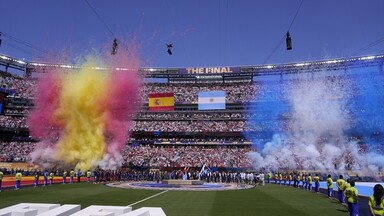
Spain’s 1-0 extra-time victory over Argentina brought the first 48-team World Cup to a close after 39 days across the US, Mexico and Canada.
The tournament produced record attendance, a generational changing of the guard, a goalkeeper who became an overnight global folk hero, and a renewed scrutiny of FIFA’s leadership. Among all of this, ten names stood out from the masses that defined this year’s tournament.
Messi arrived in North America at 39 for what he had strongly suggested would be his final World Cup, and he came close to achieving the near-impossible: winning a second consecutive title, something no nation had managed in 64 years.
He finished with eight goals and four assists, his best combined output at a single World Cup, and received the Silver Ball behind Rodri.
However, he went scoreless in the final as Argentina failed to register an attempt during regulation time before losing in extra time.
It was Argentina’s third final in the last four World Cups, following defeat in 2014 and victory in 2022, and ended with Messi in tears during the trophy ceremony.
Off the pitch, his farewell tour was the tournament's dominant emotional current from day one, every match narrated as a possible last dance, and the final itself framed as a passing-of-the-torch moment against 19-year-old Lamine Yamal, the player most often mentioned as football's next Messi.
Rodri won the Golden Ball as the tournament's best player without scoring a single goal, a reminder that the award has occasionally gone to a defensive orchestrator rather than a finisher, joining names like Zidane, Kahn and Modric on that shorter list.
His case was built on control: he led the tournament in successful passes and line-breaking passes, had the most touches of any player in the competition, and anchored a Spain defense that conceded just once in eight matches.
In the final alone, he completed 101 of 105 passes and won 80% of his duels as Spain controlled Argentina for long periods.
The story behind the numbers made his performance more significant. Rodri suffered a serious knee injury nearly two years earlier, and the Golden Ball completed a comeback that also saw him become just the eleventh man in history to win a World Cup, the Champions League and the Ballon d'Or.
Mbappe retained the Golden Boot with 10 goals, becoming the first player to finish as the World Cup’s leading scorer in consecutive editions.
He also became the competition’s all-time leading scorer with 22 career goals, one more than Messi, and the first player since Gerd Muller in 1970 to reach double figures in a single edition.
His campaign included braces against Senegal, Iraq and Sweden, a penalty winner against Paraguay and two goals in France’s 6-4 third-place playoff defeat to England, which is where he clinched the scoring title after France had been eliminated by Spain in the semifinal.
Mbappe also received the Bronze Ball, some consolation for a player who, at 27, continues to rewrite World Cup history.
At 19 years and six days, Yamal became the joint-fourth-youngest World Cup winner in history, behind Pele, Ronaldo Nazario and Giuseppe Bergomi.
He also completed a rare European Championship-World Cup double at an age when most players are only beginning their senior international careers.
His individual World Cup numbers were modest by his own standard, one goal, and a tournament that started slowly as he worked back from injury, but Spain simply did not lose a match he started across Euro 2024 and this World Cup combined.
He did not receive the tournament’s Best Young Player award, which went to his Barcelona teammate Pau Cubarsi, but few storylines carried greater symbolism than the teenager from Rocafonda standing opposite 39-year-old Messi in the final.
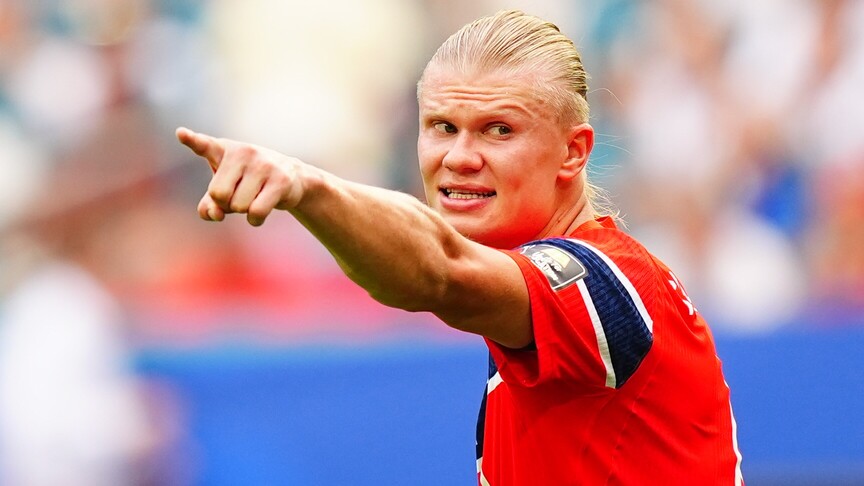
Haaland carried Norway to its first World Cup quarterfinal in the country’s fourth appearance in the competition.
He finished with 7 goals, including a brace that eliminated five-time champions Brazil in the round of 16, Brazil's earliest exit since 1990, and did it with startling efficiency, averaging a goal every 14 touches, the fewest of any player to score three or more goals at a World Cup in six decades.
Norway’s run ended in a dramatic quarterfinal defeat to England, but Haaland left the tournament after extending his scoring streak to 14 consecutive competitive internationals.
The campaign also carried a family connection. His father, Alfie, represented Norway at the 1994 World Cup in the US, when the team was eliminated in the group stage.
Haaland therefore not only led his country to a historic result but continued a journey his father began on the same continent 32 years earlier.
No player captured the spirit of a 48-team World Cup better than Vozinha, the 40-year-old Cape Verde goalkeeper, whose real name is Josimar Jose Evora Dias, helping the Blue Sharks become the smallest nation in the field to reach the knockout stage.
He kept clean sheets against Spain and Saudi Arabia, becoming the third goalkeeper ever to post multiple shutouts past his 40th birthday at a World Cup, alongside Peter Shilton and Dino Zoff.
In Cape Verde's round-of-32 exit to Argentina, an extra-time 3-2 defeat, he made eight saves, including a stop on a Messi free kick, to finish the tournament with an 18-for-23 save record.
Off the pitch, his journey through clubs in Angola, Moldova, Portugal and Cyprus, along with his background as an electrician who did not turn professional until he was 25, made him one of the tournament’s breakout figures.
His performances also transformed him into a social media phenomenon, with his Instagram following rising from thousands to more than 20 million during the tournament.
Bellingham scored seven goals, the most by an England player at a single World Cup or European Championship and a record for a midfielder at one World Cup.
Back-to-back braces against Mexico in the round of 16 and Norway in the quarterfinal carried England to the semifinals for the second time in three World Cups.
England fell to Messi’s Argentina before beating France 6-4 in a remarkable third-place playoff, with Bellingham again among the scorers.
His semifinal duel with Messi and quarterfinal meeting with former Borussia Dortmund teammate Haaland added to the tournament’s major individual storylines.
He leaves the tournament as one of England’s main standard-bearers heading into another Real Madrid season alongside Mbappe.
Olise produced one of the greatest creative campaigns in World Cup history, finishing with seven assists to break Pele’s single-tournament record of six, which had stood since 1970.
He achieved the record without scoring but set up two of Mbappe’s goals in the third-place defeat to England and remained a constant creative outlet for France.
Coming off a 27-goal, 33-assist club season at Bayern Munich, Olise's emergence as a genuine second creative hub solved a long-standing French problem and put him firmly into Golden Ball conversations, along with transfer speculation linking him to Real Madrid before he'd even left North America.
De la Fuente delivered Spain’s second World Cup title and completed a European Championship-World Cup double following the country’s Euro 2024 triumph in Germany.
The victory extended Spain’s unbeaten run in regulation time to 38 matches, the longest by a European national team.
His side conceded a single goal across eight matches, built around a settled 4-3-3 and a willingness to make selection calls that looked risky in the moment, most notably keeping Pedri on the bench for the final and being proven right.
De la Fuente built his reputation by coaching Spain’s youth and Olympic teams before taking charge of the senior side, and his story reflected that of his squad.
His years within the Spanish Football Federation’s youth system gave him firsthand knowledge of several players who became central to the senior team, while he also trusted young talents such as Yamal and Cubarsi with major roles.
Infantino oversaw the first 48-team World Cup and, by the numbers, a commercial triumph.
The tournament attracted a record 6.8 million spectators, while more than 500 million ticket requests were submitted during FIFA’s main random-selection sales phase.
Infantino also opened the door to discussions over a possible expansion to 64 teams at a future World Cup.
However, his presidency faced sustained scrutiny throughout the tournament.
Ticket prices drew criticism over affordability, although FIFA introduced a $60 ticket tier for supporters of qualified teams.
The inaugural FIFA Peace Prize awarded to US President Donald Trump at the official World Cup draw also prompted criticism and was later cited in ethics complaints concerning political neutrality.
During the tournament, FIFA suspended the automatic one-match ban imposed on US striker Folarin Balogun after Trump publicly said he had called Infantino and requested a review.
FIFA maintained that its disciplinary committee acted independently, but UEFA said the decision had “crossed a red line” and described it as unprecedented, incomprehensible and unjustifiable.
A group of 72 members of the European Parliament later called for FIFA’s Ethics Committee to investigate Infantino, while advocacy group FairSquare submitted a complaint to the International Olympic Committee’s Ethics Commission.
Infantino leaves the tournament having delivered the expanded spectacle he promised but facing some of the strongest questions yet over FIFA’s political independence.
news_share_descriptionsubscription_contact