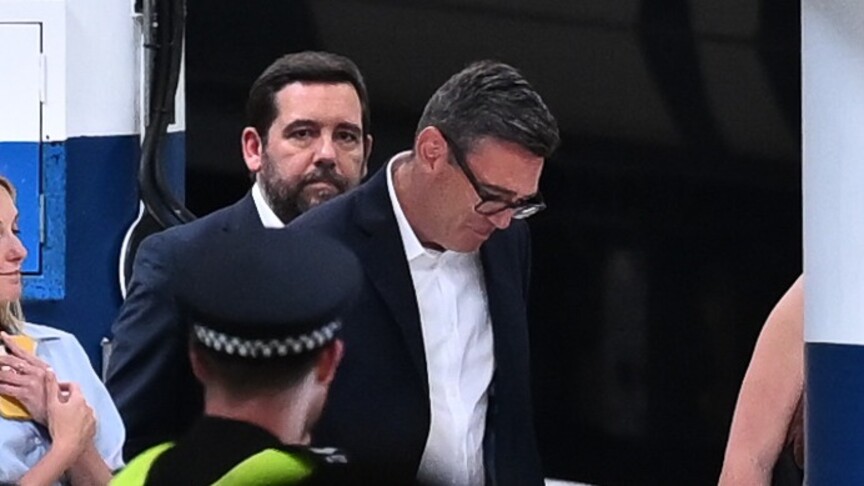
Andy Burnham pledged Friday to take Britain's Labour Party in a "distinctively Labour" direction, promising to unite the party, devolve power from Westminster and rebuild trust in politics after being elected its new leader.
In his first speech as leader, Burnham outlined a five-point plan focused on party unity, political renewal and constitutional reform.
He pledged to build "one Labour team," create "a new politics," change Labour's political direction, represent "everywhere" in the UK and shift power from Westminster and Whitehall to local communities.
Describing the third priority of his plan, Burnham said Labour would work with other parties where possible but would do so “from the clarity of knowing exactly where we stand.”
"As your leader, I will set a direction that is distinctively Labour," he said.
"We won't try to out-Green the Greens or out-Reform Reform or do what we've done in the past – wearing too many Tory clothes," he added.
In an apparent jibe at Conservative leader Kemi Badenoch, Burnham said: “I'm quite happy that Kemi doesn't approve of my wardrobe choices because I'm not keen on theirs either.”
"From here we do it differently. We win by being us – boldly, confidently, authentically us – Labour," he added.
Burnham, who appeared emotional as he took the stage, thanked party members for their support.
"Thank you, everyone. Thank you so much everybody, very much. Thank you. Thank you so much, friends. What a moment and what backing you've given me," he said.
Calling the result "a proud moment" for himself and his family, Burnham added: “This is a proud moment you have given me and my family today, and an emotional one, but it is one for which I am ready.”
Burnham says Britain took 'wrong turns' in 1980s as he sets out Labour vision
Burnham also said Britain "took a series of wrong turns in the 1980s," arguing that political power became centralized and economic power was privatized as he outlined his vision for the Labour Party.
"I am clear Britain took a series of wrong turns in the 1980s," Burnham said. "Political power was centralised, and economic power was privatised."
He said the country had "surrendered control of the essentials - housing, water, energy, transport - and left people exposed to higher costs."
Those policies, Burnham argued, led to wealth and power becoming concentrated "in the hands of fewer people and fewer places."
He added that over the past four decades, political and economic power had "drained away" from communities in every region and nation of the UK.
Burnham described his program as "the most significant change moment in our politics for 40 years."
Turning to Labour's own record, Burnham said politicians must reflect on whether they had done enough for the communities that formed the party's traditional base.
After highlighting industrial heartlands that he said had been devastated by political decisions made to "protect vested interests," he asked: "Have we been good enough for them (Labour voters)?"
"Change starts with honesty," Burnham said. "We must recognize that this generation of politicians, myself included, have failed to challenge a political culture and an economic model that simply doesn't work well enough for ordinary people."
Burnham also presented himself as a pro-business Labour leader, drawing on his record as mayor of Greater Manchester.
"I will be a pro-business leader of the Labour party as I was a pro-business mayor of Greater Manchester," he said.
"We turned places around together and that is the way we run in Manchester and we will take to the whole country."
He also addressed speculation over his future cabinet, saying he had not yet decided who would serve in his top team.
"Contrary to what you may keep on reading, I haven't made any decisions yet about who will be in that top team - but I will soon," he said.
He added that the team would reflect the diversity of both the party and the country.
"And when I have, you will see it reflects all parts of our party, all communities, and it will reflect your own place within this great party of ours, a stronger, more united Labour Party, lifting up a stronger and more united Britain."