Anadolu Ajansı © 2026


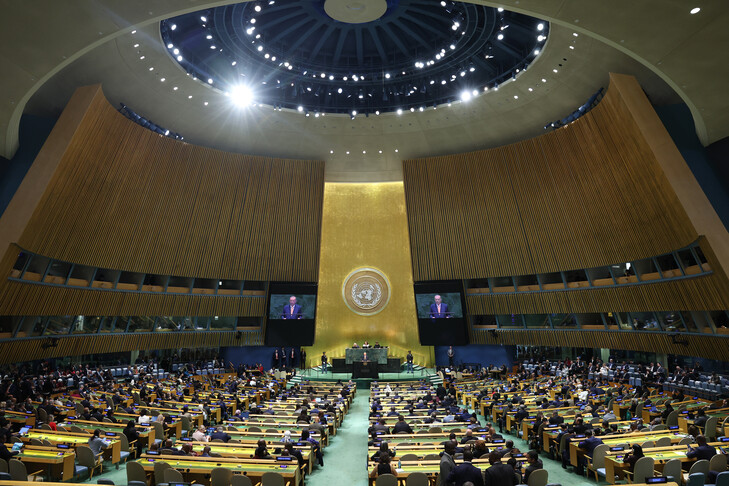
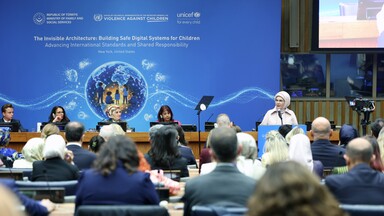
Artificial intelligence emerged as a major theme at the opening of the UN General Assembly, with world leaders warning about everything from autonomous weapons and disinformation to concentrated technological power and job disruption.
But there was little consensus over what should come next.
US President Donald Trump rejected international attempts to control AI and emphasized competition and rapid development, while several other leaders called for common rules, international safeguards and greater government oversight.
UN Secretary-General Antonio Guterres issued perhaps the starkest warning, saying humanity is increasingly transferring power to machines and insisting that decisions over life and death must remain under human control.
Here is what leaders said about AI at the 81st UN General Assembly.
Trump used his Sept. 22 address to reject international efforts to establish global controls on artificial intelligence.
“The United States also totally rejects any attempt to construct a globalist scheme of control for the Artificial Intelligence being spoken of so much now -- hereinafter officially called ‘Super Intelligence.’”
He announced that US government documents would refer to AI as "super intelligence," arguing that the word “artificial” made the technology sound less significant than it was.
He framed AI development as a strategic race, saying the country that wins the technology would gain a major advantage.
“Whoever wins SI, whoever wins Superintelligence wins,” Trump said, adding that the US was ahead of China and intended to remain so.
Trump said he would not slow AI development, arguing that it could become more significant than previous technological revolutions.
“I’m not going to stifle growth of something that will be bigger than the Industrial Revolution,” he said. “We will only encourage superintelligence. We’re going to encourage it, not rein it in.”
At the same time, he said the US would monitor the technology through the Justice Department and other law enforcement agencies and would encourage its development “safely and responsibly.”
Turkish President Recep Tayyip Erdogan called for an international legal framework on AI.
“The time has long come to establish a common international legal framework for artificial intelligence,” Erdogan said.
He called for work to be accelerated to prepare and bring into effect a UN international convention on AI.
“It is important to accelerate efforts to prepare and bring into force a United Nations International Convention on Artificial Intelligence.”
British Prime Minister Andy Burnham highlighted both the potential benefits and risks of frontier AI.
He said AI was already speeding up cancer diagnosis in the UK and could help transform healthcare, education and the economy, while also becoming a vital tool for security.
“AI will also be a source of disruption to the way we live and work – and a multiplier of risk,” he warned.
“Fundamental decisions on this technology are too important to be left to chance" Burnham said, arguing that elected governments should retain responsibility for those choices.
He announced that Britain would put AI at the heart of its G20 presidency in 2027 and work toward “a single set of global principles and standards” to ensure transparency, access, preparedness and safe AI development.
Burnham said the challenge was to harness AI’s economic and scientific benefits while avoiding the upheaval and inequality associated with earlier industrial transformations.
French President Emmanuel Macron warned against allowing the US and China, or a small group of technology companies, to dominate decision-making on artificial intelligence.
"There are some who wish to make us believe that only two powers, the US and China, will be making the decisions. They want us to believe that just a few economic actors will make all the decisions.”
He called for countries to develop their own AI capabilities and for greater oversight of AI models, saying they should not become dependent on a handful of private companies.
Macron also backed international cooperation on AI, including the development of an open-source frontier model that countries could share.
“Rather, we must come together to build an open-source frontier model, a cutting-edge model,” he said.
Macron pointed to Europe’s efforts to establish rules and principles governing AI as an alternative model.
Brazilian President Luiz Inacio Lula da Silva called for stronger regulation of Big Tech and artificial intelligence, warning against what he described as an unchecked technological race.
“It would be an unforgivable historical omission not to address the challenge of regulating the big techs and artificial intelligence,” Lula said.
He accused a small group of “techno-oligarchs” of promoting “a race with no ethical boundaries” and bypassing the UN and its scientific panel on AI.
Lula also called for greater corporate responsibility, saying companies that are aware of the risks of their products were shifting the burden of dealing with algorithms onto families.
Finnish President Alexander Stubb described artificial intelligence as a technology that could reshape science, the economy, politics and security.
He called for humans to retain control over its development.
“Artificial intelligence is the most consequential technology in the history of mankind,” Stubb said. “Humans can and should be in the driver's seat.”
He said countries faced a choice over how to approach AI: “We can compete, cooperate, or slow down,” adding that he believed cooperation was the best path.
Stubb said Finland and Norway, together with other countries, had launched a call for companies, governments, regional organizations and the UN to develop mechanisms to control frontier AI models.
UN Secretary-General Antonio Guterres warned that humans are “increasingly handing power to machines,” pointing to the growing role of AI and autonomous weapons in decisions once reserved for humans.
He said AI was rapidly concentrating power in data, computing capacity and algorithms, while advancing faster than humanity’s ability to understand its consequences.
“The danger is not technology. The danger is technology without accountability,” Guterres said, calling on governments to take responsibility for managing AI risks.
He urged countries with the greatest AI capabilities to share information on emerging safety risks, cooperate on testing and evaluation, and work toward common safeguards.
Guterres also called for a multilateral AI risk-management framework backed by credible and independent oversight, saying artificial intelligence must be “shaped by humanity, with humanity and for all humanity.”
The UN chief outlined particularly strong safeguards concerning children and warfare.
“Children must never become the test subjects for unregulated systems,” he said.
He added that “life-and-death decisions must never be surrendered to machines,” declaring: “Killer robots must have no place in our future.”
Kenyan President William Ruto raised another dimension of the AI debate: technological dependence and ownership.
In remarks at a high-level AI Middle Powers Coalition meeting on the sidelines of the UN General Assembly, Ruto said African countries needed to move beyond consuming AI products and instead develop, own and shape systems that reflect their languages, economies and societies.
“We must not reproduce the old extractive economy in digital form. Africa cannot provide the minerals, energy, data, content and talent of the AI revolution, only to import the resulting intelligence at a premium.”
Ruto called for greater investment in African computing infrastructure, skills, research and governance capacity.
news_share_descriptionsubscription_contact

contact_the_ombudsman
is_there_an_error_in_this_story