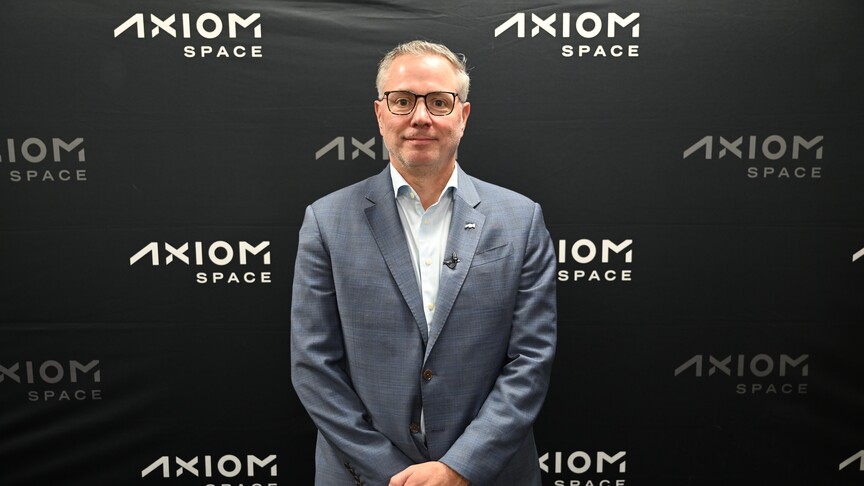
- 'I believe there is a race to create a space economy,' Cirtain tells Anadolu
US firm Axiom Space will have its commercial space station operating before the International Space Station (ISS) is retired in 2030, the company's CEO said Tuesday.
"We're waiting on a solicitation from the US government, from NASA, for the procurement of the services for that replacement to the ISS. But meanwhile, we've been using our own capital to build our space station," Jonathan Cirtain told Anadolu on the sidelines of the 77th International Astronautical Congress in Antalya.
"We have two vehicles that we are in the process of completing the manufacture of, and we'll launch in 2028 and 2029 those first two modules," he said. "The International Space Station is not set to retire until 2030. So, we'll be up and operational in advance of the ISS being decommissioned."
Rather than build its own replacement for the ISS, NASA plans to buy services from privately owned and operated space stations. The agency put out a draft call for proposals in July. Its schedule targets contract awards in spring 2027.
Axiom, a Houston-based company, has flown four private astronaut missions to the ISS. It is also developing the spacesuits NASA astronauts are set to wear on the Moon. Cirtain, a physicist, became CEO in October 2025.
'Race to create a space economy'
Asked whether the world is entering a race to build the next space station, Cirtain said the competition is broader.
"I believe there is a race to create a space economy," he said. "Now that the ISS has done 25 years of research and development to demonstrate the uses of microgravity ... it's time to use those capabilities for the benefit of humans back here on Earth."
He also pointed to a separate competition over the Moon.
"I also think that there's a geopolitical race between the United States, Europe, and its allies, Japan, Canada, for exploration of the Moon and what resources are available there," he said.
Scientists believe the Moon's south pole contains water ice. That ice could one day supply astronauts with drinking water, oxygen and rocket fuel.
"The United States, its allies, and separately, China, are all seeking to explore and find out what those resources are," Cirtain said. "Whether it's a space race or something else ... what an exciting time it is to be in space."
As an example of what research in orbit can offer, he cited the cancer drug Keytruda. Its maker, Merck, has run crystal-growth experiments on the ISS since 2014. The research helped Merck develop an injectable version of the drug, which US regulators approved in 2025.
"There's a whole set of reasons why crystals grown in space are better than crystals grown on Earth," Cirtain said. He argued that commercial stations are now needed to turn such research into actual products.
Managing a more crowded orbit
Last month, US Air Force Secretary Troy Meink said the US has weapons in orbit capable of defending its forces against hostile action. It was the most direct acknowledgment by a US official that such systems exist.
Asked how a commercial station could stay a neutral international laboratory amid such developments, Cirtain said: "I think the US government and what it might be doing for its defensive posture is kind of independent of how Axiom Station is meant to operate."
As for how he sees the future of the peaceful use of outer space, he said: "I think that is the purpose of Axiom Space. For the peaceful, purposeful use of space for the benefit of humans back here on Earth."
He said the ISS has gained extensive experience tracking and managing space debris and natural hazards such as micrometeorites. He warned, however, that growing traffic in low Earth orbit will demand more care.
"As more spacecraft are deployed, we're going to have to become more sophisticated about how we manage the use of low Earth orbit," he said. "I really hope that we are clever about the way in which we use that resource and don't saturate that resource."
Overcrowding, he added, could lead to more collisions and more maneuvers by spacecraft to avoid them.
On artificial intelligence, Cirtain acknowledged concerns over security. "I think there's a lot of interest in understanding how security around the use of AI should be considered," he said.
"But I also think that there's a lot of opportunity," he added. He said AI tools beyond the large frontier models could help operate spacecraft and make better use of data collected in orbit. "There are other types of artificial intelligence tools that I do believe benefit us."
Cooperation with Türkiye
Axiom Space and the Turkish Space Agency signed an agreement in January 2025 to explore how Türkiye's space industry could contribute to Axiom Station.
"This is an expansion of a relationship that's already existing," Cirtain said. He recalled that Axiom worked with Turkish industry and a university on a science payload for its Ax-3 mission in 2024. Alper Gezeravci, Türkiye's first astronaut, flew on that mission.
Axiom has since established a university alliance that includes Turkish institutions. Through the alliance, the company helps universities turn ground-based experiments into payloads that can fly in space.
"We see this as an ongoing relationship, and as the space ecosystem in Türkiye expands, we just see there even more opportunities for collaboration between Axiom Space and industry here in Türkiye," he said.
The congress runs through Friday.