Fatih Erel
15 March 2016•Update: 18 March 2016
GENEVA
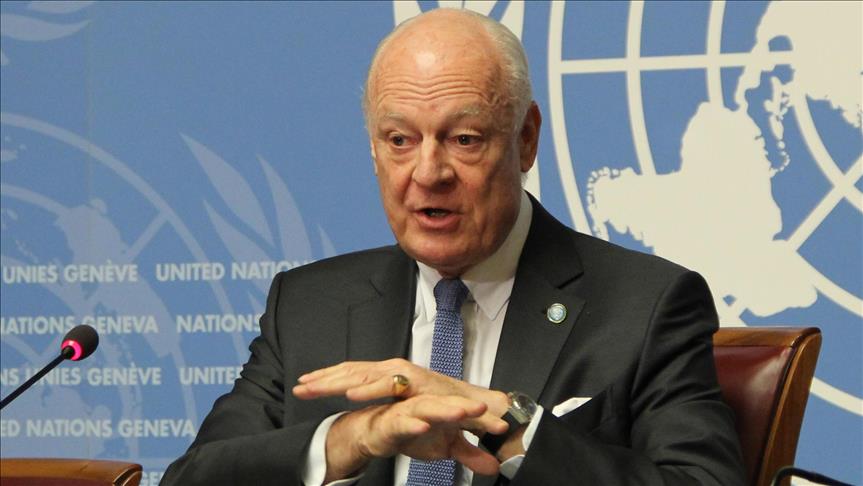
Russia’s announced withdrawal from Syria is a “significant development,” the UN envoy trying to end the five-year conflict said Tuesday.
Staffan de Mistura said he hoped the Kremlin’s surprise declaration on Monday would have a positive effect on negotiations between the Syrian government and opposition.
“It is not a coincidence, at least we should not consider as a coincidence, that the decision took place in the very beginning of intra-Syria talks,” he told a news conference in Geneva following a meeting with opposition representatives.
He met government delegates on Monday and said direct talks between the sides would happen at the “right time”.
De Mistura also revealed he had appointed a Russian expert on Middle East affairs to his team, Vitaly Naumkin.
The second round of talks in Geneva are sponsored by the UN and aim to end the war that has seen at least 250,000 Syrians killed and more than 11 million displaced, led to the rise of Daesh and sparked a refugee crisis.
The first round ended abruptly last month amid a Syrian government military offensive backed by Russian air power. Later, the U.S. and Russia agreed a “cessation of hostilities” deal that saw a dramatic reduction in fighting.
Questioned about the difference between the two sets of negotiations, de Mistura said: “l do feel there is a difference. The difference has been caused by the three factors. There has been sense of urgency. These factors are... the refugee crisis, Russian military intervention and the advance or non-defeat of Daesh.”
Opposition ready for further talks
Meanwhile, the opposition High Negotiations Committee (HNC) said they had asked to see the government’s delegation’s proposals for a transitional administration in Syria.
Bassma Kodmani said they had a constructive meeting with de Mistura that focused on the transition to peace.
“The HNC is ready to go into further detail about its plan and hopes the Assad regime negotiating team will also go into details so that the talks are substantive,” she said, referring to Syria’s President Bashar al-Assad.
She added: “We had a document that we handed in to de Mistura with the set of general principles which we believe should be guiding the transition process. The vision that the HNC has put forward will be a starting point for discussion that we would like to take into more detail in following session.”
Under a roadmap for Syria, presidential and parliamentary elections are due to be held in 18 months following the installation of a transitional government and a new constitution.
The HNC also raised the issue of humanitarian aid reaching besieged towns and villages and the release of detainees, most of which are held by the regime.
Kodmani added: “We did mention in detail the main areas of concern on the humanitarian side. We raised specific concerns for certain areas. One of them is Daraa, which is particularly victimized.”
The southwestern city had not received humanitarian aid for four years, Kodmani said.
Asked about the regime’s proposals given to de Mistura, Kodmani said the opposition had yet to see them. “We would like to see what the regime has to offer because this is all the point for us,” she told journalists.
Turning to de Mistura’s optimism on the prospect of direct talks, she added: “If he is hopeful, we will be hopeful.”