Anadolu Ajansı © 2026


TUNIS
Tourism officials are hoping that despite the cloud of political uncertainty hanging over Tunisia, the number of tourists visiting the country will, by the end of this year, have returned to the same levels seen before the revolution in 2011.
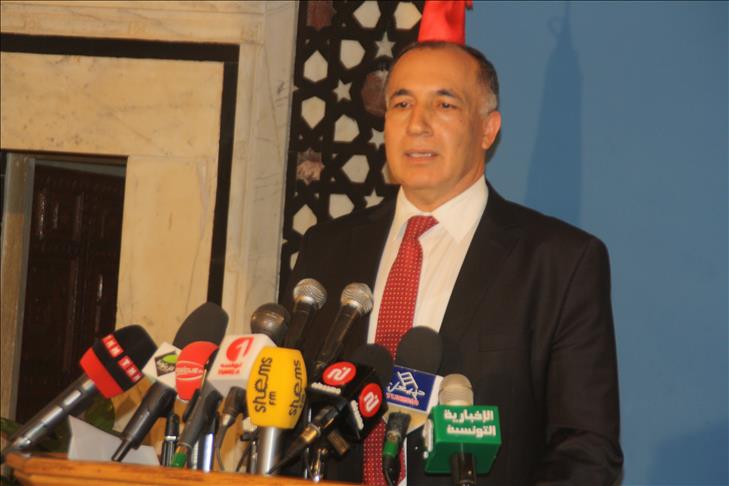
"In the first eight months of this year, we broke the 4 million barrier," Tourism Minister Jamel Gamra told Anadolu Agency in an exclusive interview.
"Our goal for this year is to draw close to the 2010 figure, which was a little below 7 million," he said. "So far we are on target."
Tourist numbers stood at 4.2 million in the period from January to August of this year, with tourism earnings remaining about 7 percent lower than before the January 2011 popular uprising that ended the Zine al-Abdine Ben Ali regime.
Tourism numbers peaked at more than 7 million in 2008, and then held steady at a few hundred thousand below that level in 2008 and 2009.
In the year that kicked off with a revolution, however, fewer than 4.6 million foreign tourists visited the country.
Local tourism picked up in summer 2011, with Tunisian families taking advantage of heavily discounted travel packages at the country's beach resorts.
Libyans, fleeing the war in their country, also helped augment hotel occupancy rates.
As political stability gradually returned, tourist arrivals nevertheless remained below the six-million mark last year.
German and Italian tourist numbers, meanwhile, are down, but visitors from the UK have overtaken their German counterparts as the second most numerous nationality on Tunisia's beaches – up by more than 22 percent from 2010.
As local tourism falls back on its staple beach-resort sector, Russians (up 45 percent since 2010) – and to a lesser extent Ukrainians and Czechs – are filling the sun-loungers left empty by the French.
More tourists from Libya, meanwhile, have also helped total visitor numbers.
The summer season has withstood Tunisia's ongoing political and security turbulence surprisingly well.
Two assassinations have recently hit Tunisia, that of leftist politician Chokri Belaid in February and of leftist politician Mohamed Brahmi in July.
Authorities blame both assassinations on radical Salafists, along with the killing of eight soldiers in a recent ambush in the western Chaambi Mountain.
Belaid's killing in February had "a very significant impact" on tourism, said Gamra, a non-partisan figure who joined the cabinet in the reshuffle that followed Belaid's assassination.
"It was the first time in the history of Tunisia that there had been a political assassination of this kind," he said. "With the second [July 25] assassination, we didn't feel such a great impact, because the summer season had already begun."
Security, meanwhile, has been stepped up at Tunisian airports in recent weeks.
"We have coordinated with hotel operators and the Interior Ministry to provide training for hotel staff on how to be alert to security issues and how to keep an eye on luggage" said Gamra.
"And now almost all hotels have said they will put video surveillance in place."
The minister insisted that since the revolution "there has been no act of aggression targeting any tourists as such out of the almost 15 million who have visited" the country.
- Sensitive French
French visitor numbers have proven particularly sensitive to political developments in Tunisia, although the French remain by far the most important contingent.
The number of French tourists visiting Tunisia is still 45 percent below its pre-revolution level, with fewer than 540,000 coming from January to August of this year – down from around 900,000 during the same period of 2010.
Gamra is not shy about blaming two French TV documentaries that he believes deterred French tourists with what he says was an exaggerated portrayal of the emergence of radical Salafist Islamists in Tunisia.
Tunisian authorities hired the French ad firm Publicis, which came up with a slogan describing the holidaymaker in Tunisia as "Libre de tout vivre" ("Free to experience everything").
"In promoting Tunisia as a destination we have been trying to show a diversified offering, with activities ranging from golfing holidays, to well-being tourism, spas and archaeological tourism," he said.
The slogan was also intended to allay fears that an Islamist-led government would mean a less relaxed tourism environment.
For decades, Tunisia pitched itself to the French market as a sun-and-sand destination.
Under the administrations of Habib Bourguiba, the first post-independence president, and his successor Ben Ali, foreign sun-seekers had been cantoned off in developments along the Mediterranean coast.
In the 1970s and 1980s, segments of the country's nascent Islamist movement began to criticize aspects of European tourism they regarded as out of tune with local culture: the "bikinis and beer" factor.
For the French market, Tunisia's 2011 revolution – and the subsequent election of a government headed by the moderate-Islamist Nahda movement – revived concerns about whether Tunisia might be a problematic tourist destination.
However an Islamist party in government has changed "absolutely nothing" in terms of strategic planning, Gamra said.
"Quite the contrary, what we are doing is to really anchor tourism as an irreversible choice for the Tunisian economy."
Tourism in a good year contributes almost 7 percent of national GDP and creates some 100,000 permanent jobs and around three times that number of seasonal jobs.
- Better services
Gamra said his ministry was hoping to raise tourist numbers by about one million each year.
"Next year we will have a more ambitious target. We want to add one million to tourists numbers every year, to reach 10 million in 2016."
He said that a deal was imminent to set up an asset management company to take on about 80 unprofitable hotels -- out of a total 800 hotels in Tunisia -- that are weighing on the local tourism and banking sectors, with their bargain basement prices and non-performing loans.
The problem arose with Ben Ali's practice of granting funding to the sector based on political allegiances, which produced investors with little entrepreneurial vision.
"We need to resolve this issue for the sake of the sector's image and the image of our business people and hotel operators," Gamra said.
"We are now in a very advanced stage of negotiations with the Central Bank for the creation of this asset management company. I think we will arrive at a good formula that everyone can agree on."
Debts will be rescheduled as hotels are either closed or converted into other uses, such as residential units or university campuses.
Gamra is aware that the sector's problems predate the revolution, stressing that "constant innovation, both in the offering and in management methods," are needed if Tunisia's tourism sector is to maintain its global competitiveness.
Gamra stresses that, in order for Tunisia to continue to compete in the global market, hotel owners must maintain international standards.
"We need to continue to monitor the quality of the offering, and to make a further effort on cleanliness," as municipal services have suffered disruption since the revolution, he said.
This month, a case of legionella bacteria was found in a hotel operated by the French arm of TUI, Europe's leading travel group.
The Tourism Ministry is now taking steps to improve public sanitation.
Pending local elections, Tunisian municipalities are still run by provisional councils appointed after the revolution.
"My message to hotel operators is that they need to be carrying out continuous renovation to hotel infrastructure," said the minister.
"For the past 15 years there have been state subsidies to support that, and we have opted to continue with that scheme, so as to encourage hotel owners to renovate."
by Eileen Byrne
englishnews@aa.com.tr
news_share_descriptionsubscription_contact