Necva Tastan Sevinc
10 September 2026•Update: 10 September 2026
- Germany asks UN court not to entertain Nicaragua’s claims over alleged support for Israel
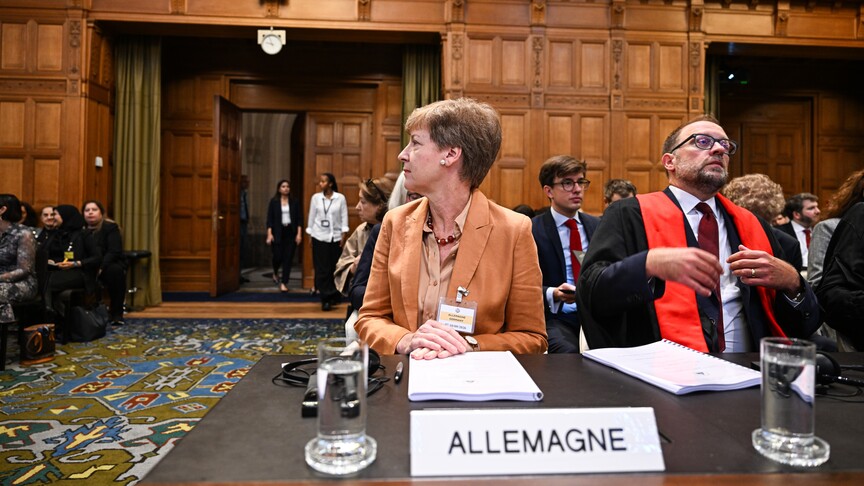
Germany supports both Israel’s security and the Palestinian people’s right to self-determination, its representative Julia Monar told the International Court of Justice (ICJ) on Wednesday.
“Germany is committed both to the existence and security of the State of Israel as well as to the full realization of the Palestinian people's right to self-determination,” Monar said during Germany’s second round of oral arguments on its preliminary objections in the case Nicaragua vs. Germany.
“Nicaragua, however, tried to portray us as one-sided. The opposite is true,” she added.
Monar said Germany supports efforts to end the conflict in Gaza and advance a negotiated two-state solution while calling for the unhindered and sustained distribution of humanitarian assistance throughout the enclave.
“The German government actively engages in all efforts to end the conflict and in supporting a negotiated two-state solution through diplomatic means available to it,” she said.
She also rejected Nicaragua’s characterization of Germany’s financial assistance to Palestinians as an abstract figure used for political purposes.
“The right of the Palestinian people to self-determination is of great importance to Germany, and the funding from Germany enables practical steps towards its realization. It makes a real and immediate difference on the ground,” she said.
Addressing German arms exports to Israel, she denied that Berlin had disregarded the court’s April 30, 2024 order.
“Let me assure you again that Germany fully respects the court's order of 30th of April 2024,” she said.
Samuel Wordsworth, a lawyer representing Germany, argued that adjudicating Nicaragua’s claims would require the ICJ to rule on whether Israel had committed genocide and other violations, despite Israel not being a party to the proceedings.
“The answer is that there must have been the commission of a genocide. In the current case, the only genocide alleged is that allegedly committed by Israel, the absent party,” Wordsworth said.
Invoking the “Monetary Gold Principle,” a rule in international law stating that an international court cannot settle a dispute if doing so requires ruling on the legal interests of an absent third-party state that has not consented to the court's jurisdiction, he said the court could not treat the allegations against Israel as already established.
“The Monetary Gold Principle is concerned with the consent of the absent third state, not the views of the parties that are before the court,” he added.
Monar concluded Germany’s presentation by asking the ICJ not to entertain any of Nicaragua’s 13 claims, arguing that the court lacked jurisdiction or, alternatively, that the claims were inadmissible.
The court is scheduled to hear Nicaragua’s second round of arguments and final submissions Thursday.
Nicaragua’s case against Germany
Nicaragua filed a case against Germany at the ICJ on March 1, 2024, accusing Berlin of “facilitating the commission of genocide” by providing Israel with political, financial and military support.
During hearings in April 2024, Nicaragua argued that Germany was Israel’s second-largest arms supplier and could not have been unaware that the munitions were being used in the genocide in Gaza.
It also pointed out that Germany had sent tank shells, drones and warship ammunition to Israel while cutting aid to Palestinians.
Germany rejected allegations that it had supported Israel’s genocide in Gaza, arguing that its arms exports complied with international law and were subject to rigorous licensing reviews.
The ICJ ruled that there was not a sufficient degree of urgency to justify ordering provisional measures but drew attention to the prolonged and widespread deprivation of food and other basic necessities among civilians.
The court’s ruling stressed that states supplying weapons to an area where genocide and other war crimes are being committed could potentially be held responsible for those crimes.
After lifting partial restrictions on arms exports to Israel, which stands accused of committing genocide in Gaza, the German government approved the delivery of around €800 million ($930 million) worth of military equipment to the country.
Following the ICJ’s rejection of Nicaragua’s request for provisional measures, proceedings will continue until a final judgment is issued on the merits of Nicaragua’s claims.