Anadolu Ajansı © 2026


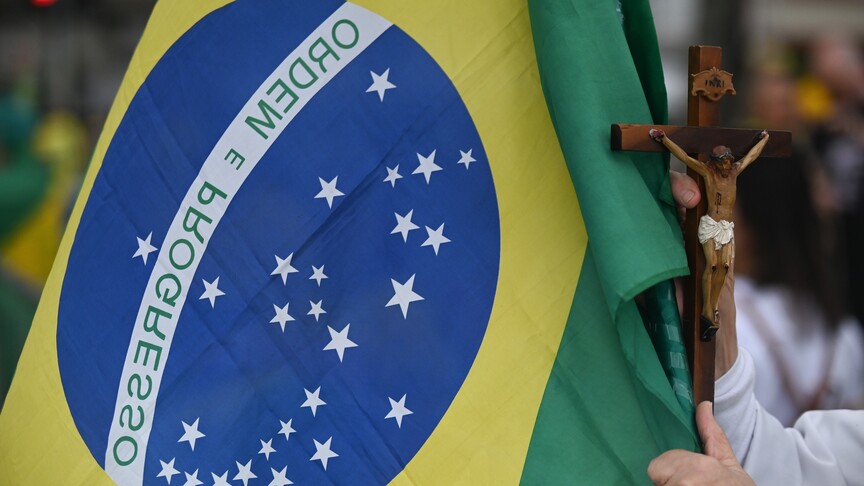
About 159 million Brazilians are eligible to head to the polls Sunday to elect their next president in a deeply polarized race marked by security concerns and bitter exchanges between the leading candidates.
At the center of the 12-candidate race are two ideological polar opposites: incumbent President Luiz Inacio Lula da Silva, of the left-wing Workers’ Party (PT), and Senator Flavio Bolsonaro, representing the conservative Liberal Party (PL).
Recent polls show Lula leading in first-round voting intentions, while surveys of a potential second-round runoff indicate a tight contest between the two candidates. A Quaest poll released Monday put Lula at 39% and Bolsonaro at 34%, while showing them tied at 42% in a runoff.
Under Brazilian election law, if no candidate secures more than 50% of valid votes Sunday, the top two will advance to a runoff on Oct. 25.
Polls will open at 8 a.m. (1400GMT) and close at 5 p.m. Brasilia time, with voters also choosing state governors, federal and state lawmakers and two-thirds of the Federal Senate.
Beyond Brazil, the election carries significant regional and geopolitical implications. Latin America’s largest economy is an agricultural powerhouse with major reserves of critical minerals, freshwater and offshore oil, while its diplomatic choices carry weight across the region.
“What is fundamentally at stake is the consolidation of Brazilian democracy,” Lucas de Souza Martins, a professor of US politics and global affairs at Temple University, told Anadolu. “Especially in the wake of the 2023 coup attempt.”
The Jan. 8, 2023, attack, when thousands of supporters of former President Jair Bolsonaro stormed government buildings in Brasilia after his election defeat, continues to hang over Brazilian politics.
Jair Bolsonaro was later convicted of plotting a coup to overturn the 2022 election result and sentenced to 27 years and three months in prison, leaving his political movement to rally around a new torchbearer.
Flavio Bolsonaro, a 45-year-old lawyer and federal senator, was chosen by his father to carry the conservative movement into the presidential race. He entered politics as a state lawmaker in Rio de Janeiro but maintained a more limited national profile before emerging as his father’s preferred candidate.
Running on a platform emphasizing tougher public security policies, market-oriented economics and conservative social values, Bolsonaro has also faced scrutiny over a Supreme Court investigation into alleged corruption and money laundering linked to financial transactions surrounding a biographical film about his father. He has denied wrongdoing.
Lula, 80, is seeking a fourth non-consecutive term after governing from 2003 to 2010 and returning to office in 2023. Running again with Vice President Geraldo Alckmin, his platform emphasizes social welfare programs, environmental protection, industrial investment and multilateral trade, including through the BRICS group.
His campaign has also faced scrutiny over investigations involving his eldest son, Fabio Luis “Lulinha” da Silva. Brazil’s Supreme Court authorized a federal police investigation into suspicions of influence peddling and corruption involving allegations that Lulinha helped a lobbyist gain access to Health Ministry officials. His lawyer has questioned the legality of the investigation and said it could be politically motivated.
Public security has emerged as a major issue for voters, particularly in Brazil’s large cities, and has featured prominently in the campaigns of both leading candidates.
“If you talk to anyone in a big city in Brazil, they know someone who got a cell phone stolen. There is a real feeling that people are not safe on the streets, and it's getting worse,” De Souza Martins said, arguing that the left has historically struggled to develop an effective public security strategy.
“That’s why Lula is now talking about re-establishing a dedicated ministry for public safety,” he added.
Flavio Bolsonaro, meanwhile, has emphasized a tougher approach to crime, including advocating US terrorist designations for Brazilian drug cartels.
Beyond the campaign rhetoric, voter fatigue is also evident after years of intense political polarization. A Datafolha survey released this week found that 47% of respondents believed public interest in this year’s election was lower than in 2022, compared with 44% who saw greater engagement.
“People are frustrated because both sides on the ballot have had their opportunity to govern, and the country still isn’t delivering what voters expected,” De Souza Martins said.
“There is a sense of disengagement, and people feel their vote won’t make a difference because the system always prevails.”
If no candidate wins Sunday, the contest will move into a three-week runoff campaign in which support from voters backing smaller candidates could become increasingly important.
“When Jair Bolsonaro announced his son would run, Flavio automatically inherited a baseline of 20% of the electorate,” De Souza Martins said.
Rachel Meneguello, a political science professor at the University of Campinas (Unicamp), said the political movement built around Jair Bolsonaro has retained a significant base despite controversies surrounding his presidency and subsequent conviction.
“Although the Brazilian right is highly fragmented across different parties, ‘Bolsonarismo’ as an identity continues to consolidate its ground,” Meneguello said.
Lula, meanwhile, has consolidated much of the left behind his candidacy. The race is unfolding as several other Latin American countries have shifted politically to the right, giving Brazil’s result broader regional significance.
The election could also reshape Brazil’s foreign policy as the country navigates its relationships with the United States and China.
Meneguello said preserving Brazil’s autonomy amid competition between the two powers would remain a central challenge regardless of the election outcome.
“Bolsonarism strongly emphasizes ideological alignment with the United States and Israel,” she said, pointing to efforts by figures on the Brazilian right to strengthen ties with Washington.
De Souza Martins said a Flavio Bolsonaro administration would likely seek closer political alignment with conservative governments in the Western Hemisphere, although Brazil’s economic relationship with China would constrain any major shift.
“China is currently Brazil's greatest trade partner, and that’s hard to change given the business interests involved,” he said.
“However, in terms of ideology and strategic critical minerals, a Flavio victory would decisively place Brazil alongside right-leaning administrations in the Western Hemisphere.”
For Meneguello, the stakes of Sunday’s vote extend beyond individual policies or Brazil’s foreign alignments.
“At stake in this election,” she said, “is the very preservation of democracy.”
news_share_descriptionsubscription_contact

contact_the_ombudsman
is_there_an_error_in_this_story