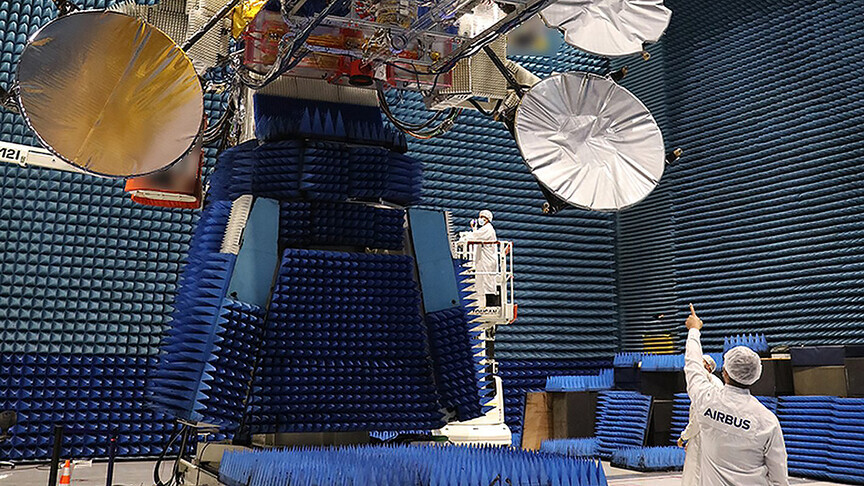
Airbus Defense and Space seeks to expand its collaboration with Türkiye to benefit from the country’s existing satellite expertise and to accelerate domestic technological capabilities.
Carlo Mirra, sales director of Airbus’ corporate business growth and development unit, told Anadolu that the company monitors Türkiye’s expanding focus and growing industrial capacity in the space sector.
Mirra said the aerospace ties between the firm and Türkiye could expand further via direct industrial collaboration or intergovernmental agreements involving Türkiye, the European Space Agency (ESA), the European Commission, or Airbus’ founding nations.
These discussions came to the fore as Türkiye prepares to host the 77th International Astronautical Congress (IAC 2026) in the southwestern city of Antalya under the coordination of the Industry and Technology Ministry and the Turkish Space Agency, with Anadolu serving as global communications partner.
Mirra expressed strong excitement about the event, noting that he has never visited Antalya before.
Mirra noted that he began working with the IAC and the International Astronautical Federation (IAF) in 1989 and currently chairs the federation’s industrial relations committee while managing ESA business relations at Airbus.
“I'm dealing primarily with European business, although I have a past in international business, especially in the US; nevertheless, we are observing here the rapid growth of the political attention and also industrial capacity in Türkiye, and as you know, our company in particular has been present in Türkiye for quite a while,” he said.
“The release of the National Space Program, the space plan, the flight of the astronauts, the ambition to have independent access to space are all important messages that the current political administration in Türkiye are giving in order to let the local industry develop and also emerge in the international environment,” he added.
Mirra stated that the IAC serves as a springboard to achieve this goal, with over 1,800 abstracts already submitted by Turkish institutions for the technical conference.
“This is providing a direct channel for Turkish researchers and industries also to present their technologies, the progress of their studies, to a truly international environment – from green propulsion to small satellite architectures, I think that this will be a very interesting confrontation for all of them,” he said.
He noted that both established firms and startups will meet international prime contractors and investors during the event.
He emphasized that establishing space diplomacy leadership is key, adding that hosting IAC 2026 demonstrates credibility in operating within a global environment.
“Türkiye is really committed to play a major role in this area, and this is proven also by the organization and investment into these events, and I think that this is providing, in terms of international cooperation, in terms of space sustainability and security, a very strong message in order to reinforce existing relationships and create new ones,” he said.
Türkiye has resources, manpower to develop capacity
Mirra highlighted that Türkiye boasts a population of 85 million people with an average age of 33, contrasting sharply with aging European demographics.
“This is a phenomenal potential to educate the space engineers and the scientists of the next decade – you have the resources (and) the manpower to develop this capacity,” he said.
“Europe is aging fast, we have ambitions in terms of programs, but the difficulty is in finding and educating qualified engineers,” he added.
Mirra noted that Türkiye’s capacity to cultivate motivated experts will fuel its long-term economic and technological objectives.
“And I'm sure that a conference like the IAC will have a very positive effect, especially with students and young generations,” he added.
Mirra stated that Airbus representatives in Ankara work at their permanent office to advance partnership-focused models.
He confirmed that negotiations with the Scientific and Technological Research Council of Türkiye (TUBITAK) remain underway.
“I observe three to four areas – there are some where the cooperation may be more direct and involved, certainly in lunar exploration,” he said, referring to ongoing talks between Airbus and TUBITAK on lunar exploration, human spaceflight, and satellite communications.
Mirra noted that Airbus played a key role in boosting capacity through the Turksat satellite program, where the aerospace giant aims to broaden its footprint.
“That is certainly an area where we would like to maintain the relationship and possibly also broaden that, either as a sort of industrial cooperation, but also under a government-to-government partnership – you know, if there is a Turkish government, for example, making a deal with the European Commission or with ESA or with some of the mother countries of Airbus, namely France, Germany, Spain, and UK, that is certainly something where we have an interest, so that is a development that we are observing with a lot of attention,” he added.