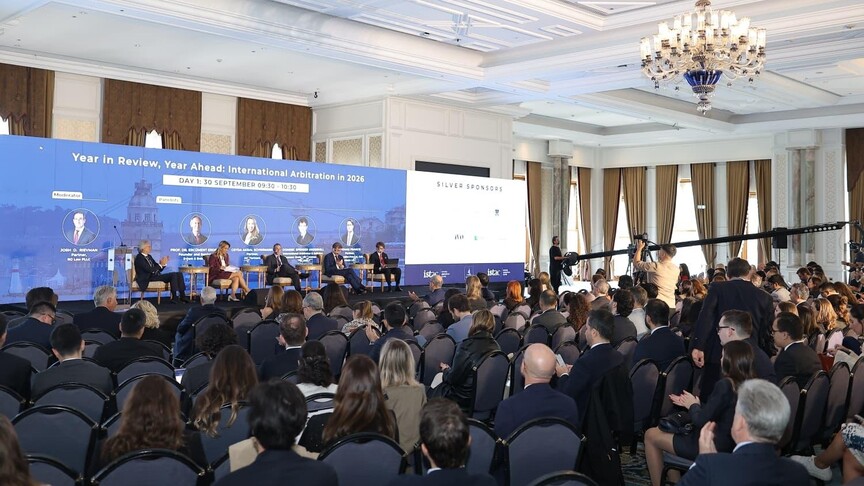
Geopolitical developments, sanctions and artificial intelligence took center stage Wednesday as international arbitration practitioners gathered for Istanbul Arbitration Days 2026.
Participants at Ciragan Palace discussed challenges in cross-border dispute resolution, including geopolitical developments affecting enforcement and arbitral seats, the growing use of AI and efforts to make proceedings more efficient.
Opening the conference, Istanbul Arbitration Centre President Ziya Akinci highlighted the institution's growing caseload and international reach, saying construction disputes represented its largest category of cases.
The center handled 263 cases last year, Akinci said, adding that both the number of cases and amounts in dispute were continuing to increase.
He said the center was also handling cases involving entirely non-Turkish parties and disputes with no connection to Türkiye.
Akinci said 86% of cases handled under its fast-track mechanism last year were completed within the prescribed three-month period.
Geopolitics enters arbitration strategy
Discussions throughout the day highlighted the growing impact of geopolitical developments and sanctions on international arbitration.
Evgeniya Neverova, a counsel at Asari Legal, speaking during a panel on geopolitical realignment and disputes, said lawyers representing Russian and Commonwealth of Independent States (CIS) clients have had to develop increasingly case-specific approaches since 2022.
She said sanctions can affect the choice of arbitral institution and seat, payments, selection of counsel, experts and arbitrators, and enforcement of an eventual award.
Neverova said parties increasingly need to consider from the outset where assets are located and whether an award can ultimately be enforced and its proceeds recovered.
In some circumstances, she said, a successful party may obtain an award only for the proceeds to remain in a frozen account because of sanctions restrictions.
Ceyda Akbal Schwimann, a partner at IAS Partners law firm, highlighted differing approaches to sanctions and enforcement across jurisdictions.
She cited recent decisions in the UK and Switzerland involving similar sanctions-related issues that reached different outcomes, describing the divergence as an emerging “enforcement fracture.”
Wolfgang Peter, a founding partner of Peter & Kim, a specialist arbitration and disputes firm, said support for arbitration remains strong, but sanctions, controls on information and technology, and other regulatory restrictions have made its operating environment significantly more complicated.
Heiko Heppner, a partner at Bird & Bird law firm, said growing fragmentation of the global legal order requires lawyers to become better at helping clients navigate conflicting regimes.
Counsel must look beyond prevailing in arbitration itself and consider the entire path toward enforcement and eventual recovery, he said.
Institutions seek faster, more flexible arbitration
Ercument Erdem, founder and senior partner at Erdem & Erdem, said institutional arbitration was moving away from excessive formality toward more active case management, with reforms increasingly focused on speed and efficiency.
“The current direction is clear: less formality, more responsibility,” he said.
Erdem said procedures were increasingly being designed around the needs of individual disputes rather than tradition.
He pointed to changes aimed at faster proceedings, early determination of claims and stronger case management as institutions respond to concerns over arbitration becoming too slow, costly and procedurally complex.
Thomas Francis, a partner at Curtis, Mallet-Prevost, Colt & Mosle LLP, said the growing use of third-party funding was also raising questions beyond who finances a claim to who ultimately owns it, particularly in investment disputes and at the enforcement stage.
He said tribunals were likely to pay increasing attention to the ownership history of claims, including issues involving jurisdiction, quantum and beneficial ownership.
AI puts human judgment under spotlight
Dominic Spenser Underhill, an international arbitrator and solicitor at Spenser Underhill Newmark LLP, highlighted recent cases in which AI-generated legal material contained fabricated or inaccurate authorities.
He argued that professional policies and guidelines alone may not be sufficient to address the risks because AI is developing too rapidly for a rules-based approach alone to provide adequate safeguards.
Underhill stressed the importance of human qualities including intellectual honesty, diligence, prudence and judgment.
He warned that problems involving AI in dispute resolution were likely to “get worse before they get better,” saying lawyers must retain intellectual independence rather than delegate professional judgment to technology.
Erdem said AI could help reduce costs and delays but should not undermine confidentiality, due process or an arbitrator's personal responsibility for decisions.
Greener arbitration
The conference also highlighted efforts to reduce arbitration's environmental footprint through greater use of digital processes, reduced paper consumption and tools to assess the carbon impact of proceedings.
Speakers pointed to sustainability measures adopted for Istanbul Arbitration Days, describing the event's approach as an example for other arbitration organizations and institutions.
Akinci also highlighted the Istanbul Arbitration Centre's environmental initiatives, including efforts to use greener materials and work toward creating an arbitration forest through tree planting.