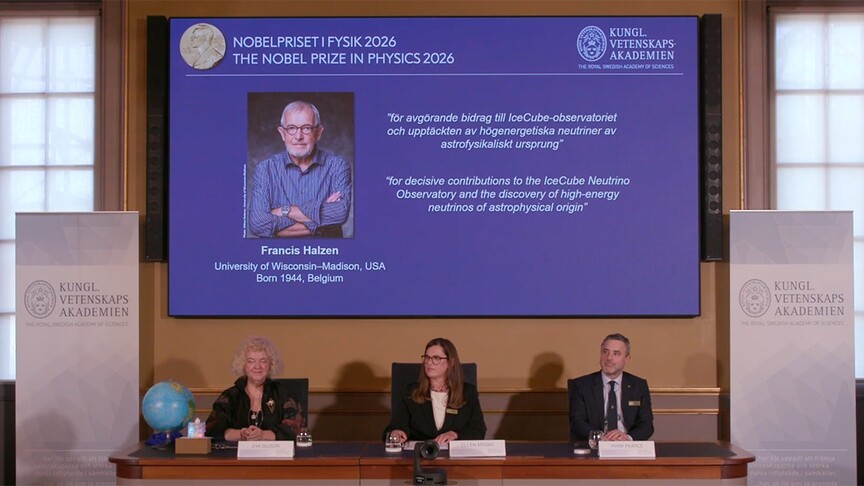
- His decades-long work helped create a new way of studying the most powerful objects in the universe
Francis Halzen’s idea was as audacious as the setting in which it would be tested: transform a cubic kilometer of Antarctic ice into a telescope capable of observing almost invisible particles arriving from the farthest reaches of the universe.
Nearly four decades after he began pursuing that plan, the Belgian-American scientist was awarded the 2026 Nobel Prize in Physics for his leadership of the IceCube Neutrino Observatory and the discovery of high-energy neutrinos originating in space.
The Royal Swedish Academy of Sciences honored Halzen “for decisive contributions to the IceCube Neutrino Observatory and the discovery of high-energy neutrinos of astrophysical origin.”
Mark Pearce, chair of the Nobel Committee for Physics, said Halzen had led an international team that created an extraordinary scientific instrument.
“His tenacity and scientific vision has paved the way for a new kind of astronomy,” Pearce said.
From Belgium to Wisconsin
Halzen was born on March 23, 1944, in Tienen, Belgium. He studied mathematics and physics at KU Leuven, where he received his master’s degree in 1966 and completed a doctorate focused on the broken symmetries of hadrons in 1969.
After working as a scientific associate at the European Organization for Nuclear Research (CERN) in Geneva, he was invited to the University of Wisconsin-Madison for what was initially expected to be a six-month research visit.
Halzen joined the university’s physics faculty in 1972 and remained there for more than five decades. He became a Vilas Research Professor and Gregory Breit Distinguished Professor, working at the intersection of particle physics, astrophysics and cosmology.
His early career coincided with the development of the Standard Model of particle physics, and he worked on its applications to particle colliders and cosmic rays. He also co-authored Quarks and Leptons, a textbook that became widely used in particle physics courses.
By the mid-1980s, however, his attention had turned toward neutrinos, electrically neutral particles with extremely small masses that rarely interact with matter.
Their elusive nature earned them the nickname “ghost particles,” but it also made them potentially valuable astronomical messengers. Unlike light, neutrinos can pass through gas, dust, planets and other matter without being absorbed or deflected.
Studying them, Halzen said, could allow scientists to “see things in the universe you couldn’t see any other way.”
Building a telescope beneath the ice
The difficulty was detecting them. A neutrino may cross enormous distances without striking a single atom, meaning researchers needed an exceptionally large and dark detector to observe the rare interactions that did occur.
In 1987, Halzen began working on the Antarctic Muon and Neutrino Detector Array, known as AMANDA. The project tested whether sensitive light detectors could be installed deep inside the Antarctic ice.
Researchers drilled holes thousands of meters into the ice using hot water and lowered cables fitted with optical sensors before the water froze again. AMANDA demonstrated that the deep ice was sufficiently clear and stable to act as a particle detector.
The experiment became the technological foundation for the much larger IceCube observatory.
Construction of IceCube began in 2004. Its final cable, or “string,” was lowered into the ice in December 2010, and its first fully equipped scientific run began in May 2011.
The completed observatory contains 5,160 optical sensors embedded in approximately one billion tons of Antarctic ice. When a neutrino occasionally collides with an atomic nucleus, it produces a charged particle that emits a faint blue glow known as Cherenkov radiation. The sensors record that light, allowing researchers to estimate the neutrino’s energy and direction.
“We started small and, to our own amazement, we overcame all these hurdles,” Halzen said.
Opening neutrino astronomy
IceCube’s breakthrough came in 2013, when the collaboration reported evidence of high-energy neutrinos arriving from beyond the solar system. The finding established that particles produced by some of the universe’s most powerful objects could be detected through Antarctic ice.
A further breakthrough followed in September 2017, when IceCube detected a neutrino with an estimated energy of 290 trillion electron volts and rapidly alerted other observatories.
Follow-up observations connected the particle to TXS 0506+056, a distant active galaxy powered by a supermassive black hole about 4 billion light-years from Earth. It provided the first compelling evidence of a source of high-energy cosmic neutrinos and demonstrated the potential of combining neutrino detections with conventional telescopes.
IceCube has since been used to study cosmic rays, dark matter, neutrino properties, the Milky Way and active galaxies including NGC 1068.
Halzen received numerous honors before the Nobel, including the Balzan Prize, Bruno Pontecorvo Prize, IUPAP Yodh Prize and the American Physical Society’s 2026 Medal for Exceptional Achievement in Research. He was elected to the US National Academy of Sciences in 2024.
Now 82, Halzen received the Nobel while in Italy and described the news as an unexpected surprise. As the sole laureate, he will receive the full prize of 12 million Swedish kronor, approximately $1.2 million.